Bilingual support is not a translation layer
A private wellness order does not become trustworthy because the store has an English button and an Arabic button. It becomes trustworthy when both languages protect the shopper in the same way.
That difference matters in Saudi ecommerce. A customer may browse in Arabic, compare product details in English, message support in Arabic, and receive a delivery update on a shared phone. If one part of that chain sounds loud, vague, or machine-translated, the whole order starts to feel less private.
The wider market is already moving in this direction. Checkout.com’s 2026 coverage of Saudi digital commerce points to more frequent online shopping, wider use of digital wallets, and a shopper who is paying close attention to security. Its MENA payments research also puts trust at the center of the buying decision, especially as digital payments become more frictionless and data-heavy. DHL’s 2026 ecommerce work reaches a similar retail lesson from another angle: shoppers do not only respond to reach and speed. They look for signals that feel real.
For a private wellness store, language is one of those signals. A good Arabic support line should not sound like a direct English export. A good English support line should not expose more than the shopper needs. Both should be clear, neutral, and specific.
What bilingual support has to protect
The support layer sits close to the most sensitive parts of the order: product questions, address correction, payment confirmation, delivery timing, returns, and private requests before checkout. It is also where a store can collect too much information without realizing it.
SDAIA’s public guide to the Saudi Personal Data Protection Law frames data protection around transparency, accountability, security, and understanding the personal data an organization holds. A small ecommerce store should not turn every support page into legal language. But the principle is still practical: ask for what is needed, explain why, and avoid pulling product detail into public messages.
For Laylati, support wording should protect five things:
- The shopper’s screen privacy.
- The parcel’s outside identity.
- The payment and order reference.
- The delivery address and phone number.
- The customer’s ability to ask a question without explaining too much.
This is why bilingual support belongs beside discreet packaging, shipping and delivery, and the store’s privacy policy. The shopper is not separating those pages in their mind. They are asking one simple question: can this store handle my order quietly?
English should stay neutral, not playful
English ecommerce copy often drifts into personality. That can work for fashion, skincare, or gifts. It is risky for private wellness.
Words such as “fun”, “spicy”, “naughty”, “wild”, or “secret pleasure” may look like ordinary category language on global adult retail sites. They are the wrong register for a Saudi-facing private wellness store that needs to survive mobile browsing, payment review, delivery messages, and household privacy.
Better English support language is practical:
- Private support
- Neutral packaging
- Order question
- Delivery timing
- Payment confirmation
- Product format
- Care and storage
These phrases are not timid. They are precise. They give the customer a way to ask for help without repeating the most sensitive part of the order.
Arabic should feel local, not machine translated
The Arabic version needs the same restraint, but it should not sound like English words moved into Arabic order.
A direct translation of “private wellness” may become heavy or awkward. A direct translation of product categories may become too explicit. A support page should use Arabic that feels natural for service, privacy, and order handling.
Useful Arabic phrases for the Laylati support layer include:
- دعم خاص: private support.
- تغليف محايد: neutral packaging.
- توصيل بسرية: discreet delivery.
- تحديث الطلب: order update.
- رقم الطلب: order number.
- تأكيد الدفع: payment confirmation.
- طريقة الاستخدام والعناية: use and care guidance.
- تواصل معنا بسرية: contact us privately.
These are service terms, not category slogans. They let the shopper move through the store without feeling that every message is announcing the product type.
The Arabic interface also has to respect layout. Short labels help on mobile. Long Arabic strings can break buttons, search boxes, product cards, and checkout rows if they are not tested in right-to-left mode. Translation is not finished until the screen is tested on a real mobile viewport.
Support should ask less, then solve more
A strong private support system does not ask the customer to restate the product unless it is necessary. In many cases, an order number is enough.
For example, a failed delivery message should not say:
Please confirm the product you ordered and explain when you need it.
That asks for unnecessary detail and puts the customer in an awkward position. A better message is narrower:
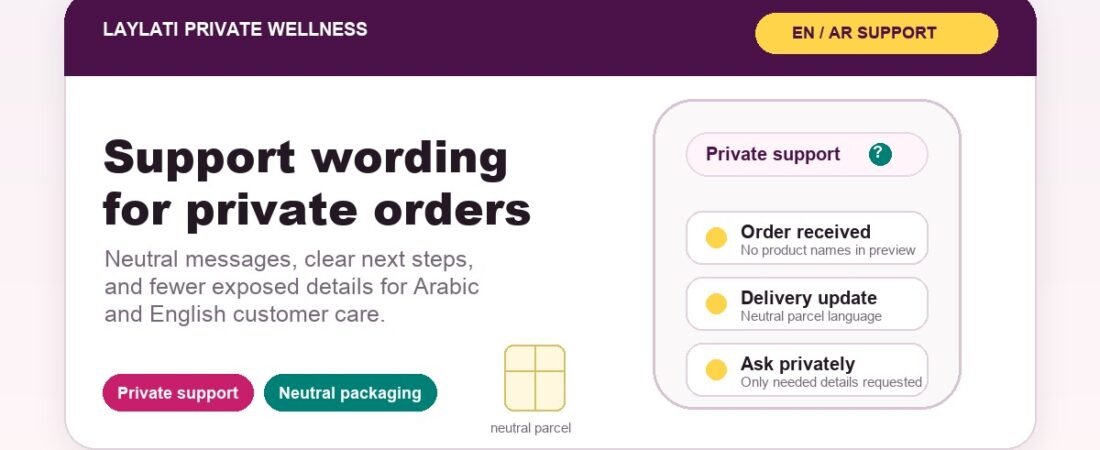
Please send your order number and preferred contact time. We will review the delivery update privately.
Arabic can follow the same logic:
يرجى إرسال رقم الطلب ووقت التواصل المناسب. سنراجع تحديث التوصيل بسرية.
The goal is not to make support colder. It is to make support safer. The customer should feel that the store already understands the category and does not need them to describe it repeatedly.
Where bilingual support should appear before checkout
Support wording should not wait until something goes wrong. It should appear before the order is placed.
On Laylati, the strongest places for bilingual support language are:
- The header or support link: “Private support / دعم خاص”.
- The product page reassurance area: “Ask privately before ordering / اسأل بسرية قبل الطلب”.
- The cart or basket: “Need help with delivery timing? / تحتاج مساعدة بخصوص وقت التوصيل؟”
- The payment page: “Payment confirmation uses neutral order language / تأكيد الدفع يستخدم صياغة محايدة”.
- The delivery page: “Neutral parcel, discreet updates / تغليف محايد وتحديثات بسرية”.
This matters because support is not only a complaint channel. It is a conversion surface. A shopper comparing Realistic Forms, Torso Series, or Pumps may have a practical question before ordering. If the only visible path is a generic “Contact us”, the store loses a chance to reduce hesitation.
Order messages should be bilingual without becoming noisy
Bilingual order messages are easy to overdo. A long English sentence followed by a long Arabic sentence can turn a simple notification into a block of text. That is especially bad on a lock screen.
For public-facing previews, keep the message short:
Your Laylati order has been received. رقم الطلب جاهز للمراجعة.
For private order pages, give the detail:
- Order number.
- Payment status.
- Delivery city or area.
- Support route.
- Packaging note.
The distinction is important. A lock-screen message should be quiet. A logged-in order page can be useful. A support chat can be specific after the customer chooses to continue.
This is also where Laylati’s earlier guide to neutral delivery messages fits. Delivery language, payment language, and support language should be designed as one chain, not three unrelated pages.
Do not let Arabic carry the risky words
One common mistake in bilingual private wellness retail is to make English careful and Arabic blunt. That usually happens when product names, badges, or category labels are translated literally after the design is already finished.
That is the wrong sequence. Arabic should be planned first for the sensitive parts of the journey:
- Header navigation.
- Search field text.
- Product-card badges.
- Add-to-cart and quick-view buttons.
- Support prompts.
- Delivery and payment notices.
- Empty cart and checkout states.
A phrase can be accurate and still wrong for the surface. Product detail can sit inside the product page where the shopper expects it. A navigation item, SMS preview, or cart badge should stay more neutral.
A short wording checklist for Laylati
Before publishing Arabic or English support copy, Laylati should check every line against five questions:
- Could this text appear on a shared phone without embarrassing the shopper?
- Does it ask only for the information needed to solve the issue?
- Does Arabic sound like customer support Arabic, not translated ad copy?
- Does English avoid playful adult-retail wording?
- Does the message tell the shopper the next step clearly?
If the answer is yes, the wording is probably close. If the line sounds clever, it is probably doing too much.
How shoppers can use this before ordering
Before placing a private wellness order, do not only compare price and product photos. Read the support and delivery wording too.
A reliable store should make it easy to understand how to ask a private question, how the parcel will be described, how payment confirmation will appear, and what information support may request if delivery needs attention. The language should be calm in English and natural in Arabic.
Laylati is building its store around that standard: clear product pages, neutral parcel handling, bilingual support, and category guidance that helps the shopper decide without exposing more than necessary. If a product format, order note, or delivery step is unclear, ask private support before checkout rather than guessing after payment.