A private order can become less private after checkout
The quietest product page can still be undone by one careless message after payment.
A shopper may choose a neutral parcel, read the discreet packaging page, check the delivery notes, and place the order carefully. Then a lock-screen notification, delivery SMS, email subject line, or failed-delivery message says too much. The item itself may be packed correctly, but the communication around it has already made the purchase feel exposed.
That is why neutral delivery messages deserve the same attention as product photos and checkout security. For private wellness orders, post-purchase communication should not be decorative. It should answer practical questions without repeating unnecessary product detail.
The wider ecommerce market is moving in the same direction. DHL’s 2026 ecommerce research says premium delivery and returns are becoming mainstream, with the UAE and Saudi Arabia among the markets where logistics subscriptions are already leading. nShift’s 2026 delivery analysis puts the old delivery basics in plain terms: convenience, clarity, and communication still decide whether shoppers buy and return. Checkout.com’s 2026 Saudi payments coverage also points to a more security-conscious shopper, with payment trust now tied directly to loyalty and cart abandonment.
For Laylati, the lesson is sharper: delivery communication has to be clear enough to reduce anxiety, but neutral enough to protect the shopper’s context.
The order confirmation should confirm, not reveal
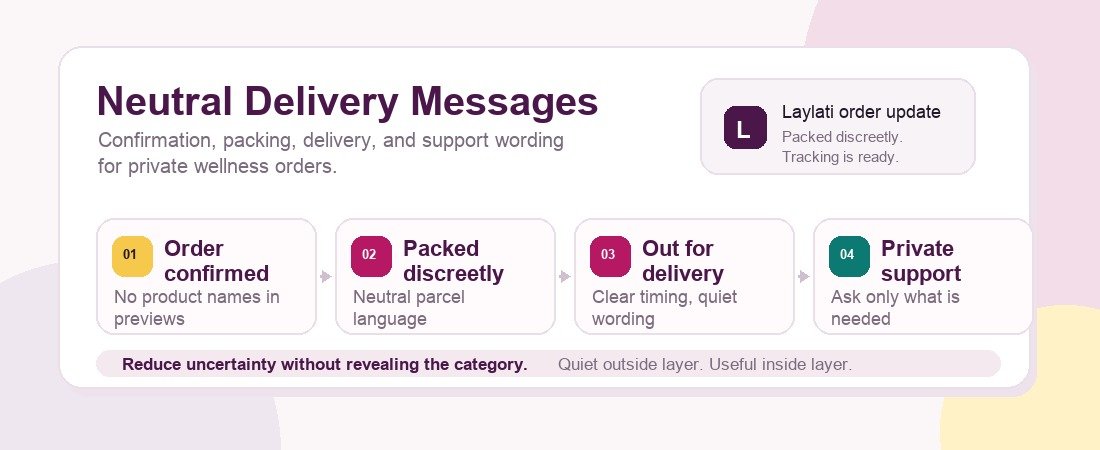
The first message after checkout has one job: confirm that the order exists and explain the next step.
It does not need to list the full product name in the subject line. It does not need to describe the category in a preview snippet. It does not need to repeat the exact item title in a push notification that may appear on a shared screen.
A better confirmation message keeps the visible layer simple:
- Order received.
- Order number.
- Total paid or pending amount, where appropriate.
- Delivery city or area, not the full address in the preview.
- Next update: packing, dispatch, or support review.
The detailed order page can hold more information behind login or a private link. The public-facing notification should not carry more than the shopper needs at that moment.
This is not about hiding basic commerce information. It is about putting information in the right place. A private order needs a quiet outside layer and a useful inside layer.
Packing and dispatch messages should explain the parcel
The packing stage is where many private shoppers want reassurance. They are not only asking when the parcel will ship. They are asking what the parcel will look like, what name may appear, and whether someone at home or at a pickup point can guess the contents.
A good dispatch message should therefore link clearly to the store’s shipping and delivery information and explain the neutral parcel standard in plain terms. It should not create a new marketing moment. This is not the time for playful copy or product-led recommendations.
For private wellness, the best dispatch message usually answers four questions:
- Has the order been packed?
- Has it left the store or warehouse?
- Where can the shopper check tracking?
- Who can help if the address or delivery timing needs attention?
That is enough. A shopper does not need a branded flourish. They need the parcel to move, the language to stay neutral, and the support path to be easy to find.
Delivery updates need restraint
Delivery notifications are often read in public. A phone may be on a desk, in a car, at a family table, or in a workplace. The message may appear while someone else is looking at the screen.
For that reason, “out for delivery” and “delivered” messages should be the most restrained messages in the whole journey. They should avoid category words, product names, and unnecessary personalization. They should say what happened, where to check status, and what to do if the parcel is not received.
Saudi Post’s public privacy notice shows how much delivery work depends on personal data: address details, email and phone numbers, payment information, shipment data, geolocation, notifications, and customer support can all sit inside a logistics journey. That does not mean every store should discuss legal compliance in every message. It does mean the message design should respect how sensitive address, phone, and shipment information can feel.
For a Laylati shopper, a strong delivery update might say:
Your Laylati order is out for delivery today. Track it here or contact private support if the delivery time needs attention.
A weaker message would repeat the item name, describe the category, or add promotional language. The shopper already bought. The message should now protect the experience.
Failed-delivery messages are trust moments
A failed delivery is not only a logistics problem. For a private order, it can become a privacy problem quickly.
If a driver cannot reach the shopper, if the address needs clarification, or if a pickup location becomes necessary, the store should move the conversation into a controlled support channel. The message should not ask for more personal detail than needed. It should not ask the shopper to explain why the order matters. It should not turn a delivery issue into a product conversation.
Good support wording is narrow:
- We need to confirm delivery timing.
- We need one address detail corrected.
- We need to arrange a second attempt or pickup option.
- We need a safe way to contact you.
It should also be easy to reach a real support path. Laylati’s contact page and the guide to private support before ordering should eventually work together: shoppers should know before checkout what support will and will not ask.
Payment messages should stay separate from product detail
Payment trust is now one of the strongest signals in Saudi ecommerce. Checkout.com’s June 2026 Saudi digital commerce coverage says Saudi shoppers are buying online more often, using digital wallets more frequently, and paying closer attention to security. Its MENA report also shows how strongly shoppers want payment to feel seamless while still being secure.
Private wellness stores should treat payment messages with that same discipline. A receipt or payment notice should confirm payment status, currency, and order reference. It should not repeat sensitive item language where the store can avoid it.
This is why discreet billing and secure checkout belong beside delivery communication. The shopper is not judging each message separately. They are judging the whole chain: product page, payment page, confirmation, dispatch, delivery, and support.
If one part feels careless, the rest feels less reliable.
Privacy notices should support the message, not bury it
SDAIA’s public PDPL guidance emphasizes privacy notices as a way to tell individuals what personal data will be collected, how it will be used, and how it will be protected. For an ecommerce store, that principle should show up in ordinary shopping language, not only in a long policy page.
For private wellness, that means the shopper should be able to understand three things before ordering:
- What information is needed to deliver the parcel.
- What information is used for payment, support, tracking, and notifications.
- Where to ask for help if a delivery or privacy question is sensitive.
The policy page can carry the formal detail. The checkout and delivery pages should carry the practical version. A shopper should not need to read a legal page to know whether a delivery SMS will be neutral.
A simple checklist for private order updates
Before a shopper places a private wellness order, the store should be able to answer these questions:
- Will email subject lines and SMS previews avoid product names?
- Will tracking pages use neutral order language?
- Will the parcel label avoid category words?
- Will failed-delivery messages move into private support quickly?
- Will payment and delivery messages stay separated from product detail?
- Will support ask only for the information needed to solve the issue?
- Will Arabic and English messages eventually be written natively rather than machine-translated?
That last point matters. For Saudi shoppers, neutral English is not enough. Laylati should build Arabic delivery and support wording that feels natural, restrained, and specific. Phrases such as تغليف محايد, توصيل بسرية, and دعم خاص are closer to the right register than direct product-category language.
How Laylati shoppers can use this before ordering
When comparing Starter Sets, larger formats, or accessories, do not only look at the product card. Check the surrounding order experience.
Start with the product page, then read the packaging, delivery, checkout, and support pages. If the message chain is clear and neutral, the store is doing the work private shopping requires. If the delivery and payment language is vague, loud, or overly detailed, ask before checkout.
A discreet order is not just a discreet parcel. It is a discreet sequence: search, compare, pay, pack, notify, deliver, and support. Each message should make the shopper feel more certain, not more visible.
Laylati’s category pages and support guides are being built around that standard. Compare the product format first, then use the trust pages to check how the order will be handled before it leaves the screen and becomes a parcel.
Sources and further reading
- DHL: 2026 E-Commerce Trends Report
- nShift: What are the three Cs of ecommerce deliveries in 2026?
- Checkout.com: Mastering payments in Saudi Arabia’s digital economy
- Checkout.com: MENA Digital Commerce 2026
- SDAIA: Guide to the Saudi Personal Data Protection Law
- Saudi Post | SPL: Privacy Notice
- parcelLab: Guide to Shipping Notifications