
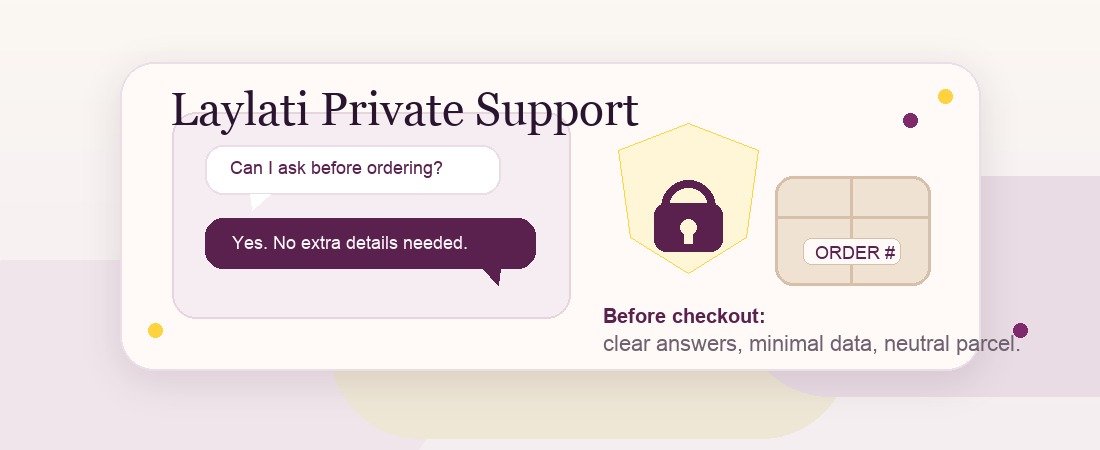
A private question before checkout is not a sales lead to squeeze. It is a trust test.
That is especially true in Saudi ecommerce now. Checkout.com’s June 2026 Saudi payments analysis says payment security has become directly tied to loyalty and checkout completion, with shoppers leaving baskets when safety is in doubt. DHL’s 2026 ecommerce trends work points in the same direction from another angle: convenience matters, but trust, delivery choice, and privacy concerns still shape whether people finish an order.
For private wellness shoppers, support sits between those two pressures. The customer wants a quick answer, but not a careless one. They may need to confirm a material, understand neutral packaging, check what appears on a receipt, or ask whether account creation is required. The support conversation should make the order feel clearer, not more exposed.
Good Support Starts With The Smallest Necessary Question
The first rule is restraint.
If a customer asks about materials, support does not need a full name, address, or phone number. If the question is about delivery timing, support may need the city or region, but not a complete address at the first step. If the customer asks about billing wording, support can explain the general process without asking what they plan to buy.
That approach fits the spirit of data minimization. SDAIA’s public data-protection materials and minimum-personal-data guidance both point toward purpose-linked collection: ask for what is necessary, and avoid collecting more than the situation requires.
For a private wellness store, this is not abstract compliance language. It is practical retail behavior.
Support should be able to say:
- We can answer product-material questions without personal details.
- We only need delivery location details when checking shipment feasibility.
- We do not need sensitive personal background to answer care, format, or packaging questions.
- If an order number is needed after purchase, the customer can provide that instead of repeating private details.
The less a customer has to explain, the more professional the support experience feels.
What Support Should Ask Before Checkout
A careful support flow usually asks for context, not identity.
For product format questions, the useful information is the product category or item name. For example, a customer may ask about realistic forms, torso series, pumps and accessories, or starter sets. Support can answer in terms of materials, care needs, what is included, and how the item is packed.
For delivery questions, city-level information is often enough for a first answer. Support can explain whether the parcel is neutral, how tracking is usually handled, and where the shopper can read the store’s discreet packaging and shipping guidance.
For checkout questions, the conversation should stay practical: available payment methods, SAR totals, account requirements, billing wording, and how to contact support after payment. Laylati’s guides on guest checkout, secure checkout, and discreet billing cover different pieces of the same trust chain.
What Support Should Not Ask
Support should not make a private shopper feel interrogated.
Before an order exists, a discreet wellness store generally should not ask for:
- full home address when only a general delivery question is being asked
- ID details for ordinary product questions
- relationship details or personal background
- medical history or intimate personal explanations
- photos from the customer unless there is a clear, necessary after-sales reason
- account passwords, OTPs, card numbers, or payment credentials
- product-use details that are not needed to answer the question
Some after-sales cases may require order information. That is different. A support team may need an order number, email, or delivery reference to solve a real fulfilment issue. But the purpose should be clear, and the request should match the problem.
In sensitive retail, unnecessary questions are not just inefficient. They are a trust leak.
Good Support Explains Boundaries
The strongest support teams do not only answer questions. They set clean boundaries.
That means being able to say what the store can confirm and what it cannot. Product pages can explain materials, size, care, inclusions, packaging, and checkout basics. Support can clarify those points and point the customer to the relevant page. But support should not make medical claims, legal promises, or religious assurances that the store cannot properly support.
For Laylati, that boundary matters. The site can help shoppers compare formats, understand care basics, read material notes, and check privacy pages. It should not pretend that a short chat replaces professional advice or local legal review.
The right tone is calm and practical:
- This is what the product page says.
- This is what is included in the parcel.
- This is how the order is usually confirmed.
- This is where privacy and packaging are explained.
- If you need a detail that is not listed, we can check it before you order.
That kind of answer is not dramatic, but it is useful.
Support Is Part Of Checkout Confidence
Checkout.com’s Saudi analysis describes a market where online purchasing is becoming more frequent and payment confidence matters more. The International Trade Administration’s Saudi ecommerce guide also describes a growing online-shopping channel supported by high smartphone use and a stronger regulatory environment.
In that context, support is no longer a back-office function. It is part of the checkout surface.
A customer who gets a careful answer before payment is more likely to trust the rest of the order path. A customer who receives a vague answer, a pushy reply, or a request for unnecessary personal information may leave without ever reaching the payment page.
Private wellness retail makes this effect sharper. The customer is not only comparing price. They are judging discretion, wording, response quality, and whether the store understands the sensitivity of the purchase.
A Pre-Purchase Support Checklist
Before ordering from any private wellness store, a shopper can use this checklist:
- Can I ask a product question without giving unnecessary personal details?
- Does support explain materials, care, packaging, and delivery in plain language?
- Is the privacy policy easy to find before checkout?
- Does the store explain neutral packaging and order communication?
- Does the support path avoid asking for passwords, OTPs, card details, or irrelevant personal information?
- Are category pages and guides linked clearly enough to answer common questions?
- If I need after-sales help later, will an order number be enough to start the conversation?
If the answer to those questions is unclear, ask before paying. A serious private wellness store should be able to answer without making the customer feel exposed.
The Laylati Standard
Laylati should treat private support as part of the product experience.
That means support should be specific, restrained, and connected to the store’s actual pages. It should help customers compare formats, understand care and materials, check packaging language, and review privacy expectations before checkout. It should also avoid collecting more personal detail than the question requires.
The next improvement is not only adding more articles. The site still needs cleaner template output, stronger product photography, and eventually a real WooCommerce product and checkout layer. But a better support standard can start now: fewer unnecessary questions, clearer answers, and a calmer path from first question to private order.
Sources reviewed
- Checkout.com, `Mastering payments in Saudi Arabia's digital economy`, published June 19, 2026
- DHL Group, `DHL E-Commerce Trends Report 2026: Old rules don't apply in the age of AI`, published June 2, 2026
- International Trade Administration, `Saudi Arabia – eCommerce`, last published May 19, 2026
- Checkout.com, `Trust in the Digital Economy 2025 Report`
- SDAIA, `Data Protection Law`
- SDAIA National Data Governance Platform, `Minimum Personal Data Determination Guideline – Details`
Before ordering, use Laylati’s contact page to ask practical questions about materials, packaging, delivery, or billing. A private support conversation should clarify the order without asking for more personal detail than the question requires.