
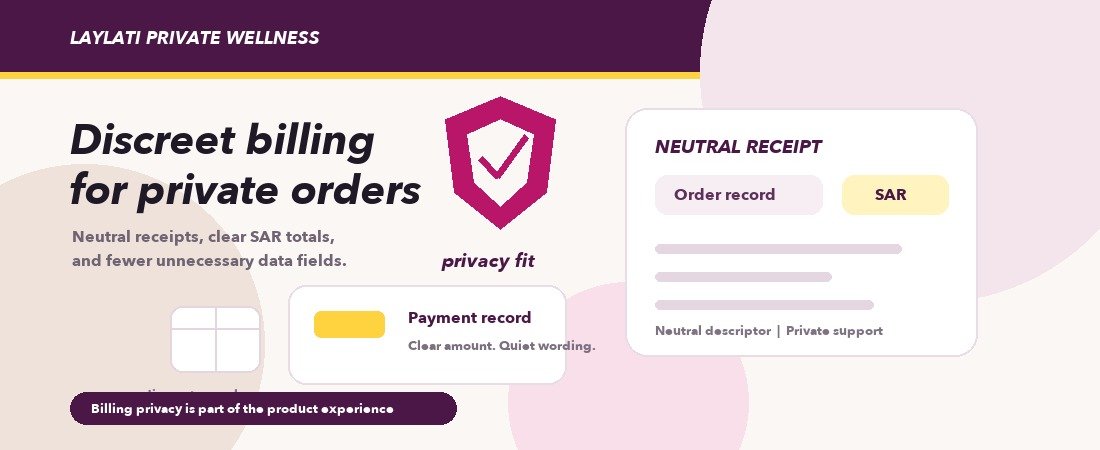
Saudi shoppers are paying online more often, and that changes what privacy has to mean at checkout.
In April 2026, the Saudi Central Bank announced through the Saudi Press Agency that electronic payments accounted for 85 percent of total retail payments in 2025. The International Trade Administration’s May 2026 Saudi ecommerce guide also describes online shopping and payments as an increasingly viable sales channel, with ecommerce expected to keep taking a larger share of retail.
For everyday purchases, that shift is mostly about speed. For private wellness orders, it is about confidence. A customer is not only checking whether the card form works. They are looking at the billing name, the receipt, the order confirmation, the message tone, and the amount of personal information requested before payment.
That is the difference between a checkout that merely processes money and a checkout that understands privacy.
The billing name should not surprise the customer
Discreet billing starts with a simple question: what will the customer see after payment?
A private wellness store should avoid vague promises such as “100% private” if it cannot explain what that means. The better approach is more practical. Before payment, the store should tell shoppers whether the payment or order confirmation uses a neutral business name, whether the receipt describes the product category in plain but non-explicit language, and where the customer can ask if they need reassurance.
This matters because digital payment records live in more places than a parcel label. A shopper may see a bank notification, an email receipt, a wallet record, an order page, or a customer-support message. The store does not need to turn checkout into a legal memo, but it should reduce avoidable surprises.
For Laylati, that principle belongs beside discreet packaging. A neutral parcel is only one part of the experience. The order record should be considered with the same care.
Receipts should be clear without being careless
A receipt has two jobs. It has to be useful for the customer, and it has to avoid unnecessary exposure.
Useful means the customer can check the amount, currency, order date, support path, and delivery status. Careful means the receipt does not shout sensitive product language when a quieter description would do the job.
The right balance is not secrecy at any cost. A customer still needs enough information to understand what was purchased and how to get help. The weak version of privacy is hiding so much that support becomes confusing. The stronger version is a receipt that is calm, neutral, and easy to reconcile.
That is especially important for product categories such as starter sets, realistic forms, torso series, and pumps and accessories. Different products may need different support details, but none of them benefit from loud billing copy.
Order privacy is also a data-minimization question
Saudi Arabia’s official data-protection framework is not written as shopping advice, but it gives private ecommerce a useful discipline: collect and retain what is needed for a clear purpose, not everything a form can ask for.
For a private wellness shopper, that turns into practical questions:
- Is this field required for payment or delivery?
- Is account creation necessary, or can the order be placed with fewer steps?
- Is the privacy policy easy to find before payment?
- Are delivery updates and support messages explained in plain language?
- Does the store avoid collecting personal notes or preferences that are not needed to complete the order?
SDAIA’s public data-protection materials describe personal data rights and controller obligations, and its minimum personal data guidance emphasizes that collection should be linked to purpose and limited to what is necessary. A shopper does not need to read regulation line by line to use that standard. If a checkout asks for information that does not feel connected to payment, delivery, or support, that is a trust problem.
Laylati’s Privacy Policy should be read as part of the checkout path, not as a page hidden in the footer.
For the wider checkout context, Laylati also keeps separate guides on guest checkout for private online shopping and secure checkout for private orders. Billing privacy sits between those two questions: how little the customer has to disclose, and how carefully the payment path handles what remains.
Digital payments raise the standard for private support
The World Economic Forum’s 2026 piece on Saudi Arabia’s digital consumer market describes search, selection, payment, and fulfilment as one continuous action. That is how many shoppers already experience ecommerce: they expect the product page, payment step, confirmation, delivery tracking, and support to behave like one connected service.
Private wellness retail has to meet that expectation without becoming intrusive.
A good support flow should be able to answer billing questions before the customer pays. It should also help after payment without forcing the customer to repeat sensitive details in a public or uncomfortable channel. A short order number, a neutral subject line, and a clear contact route can do more for confidence than exaggerated privacy claims.
This is why private support matters before checkout. If a shopper has to ask what will appear on a receipt, the answer should be specific.
What to check before paying
Before placing a private wellness order in Saudi Arabia, look for these signals:
- The site explains discreet packaging separately from billing and receipt language.
- The checkout shows the total in SAR clearly before payment.
- The store avoids unnecessary account or profile requirements.
- The privacy policy is visible before personal details are submitted.
- The order confirmation sounds neutral and practical.
- Support is available for billing, receipt, and delivery questions.
- Product pages link to category, care, and privacy information instead of relying only on promotional wording.
None of these points requires dramatic language. In a sensitive category, the best privacy signals are often quiet: fewer surprises, fewer unnecessary fields, and cleaner words in the places where records remain.
The Laylati standard
Laylati should keep treating billing privacy as part of the product experience, not an afterthought.
That means neutral order communication, clear SAR pricing, careful privacy wording, practical support, and product pages that help customers compare before they pay. It also means being honest about what the current site still needs to improve: cleaner product photography, a stronger real checkout layer, and tighter template cleanup across older WordPress surfaces.
For now, shoppers can use Laylati’s category pages to compare formats, read the discreet packaging page before ordering, and contact the store if a billing or receipt detail needs confirmation.
Private ecommerce is not built on one promise. It is built on dozens of small, quiet details that make the order feel controlled from product page to payment record.