The checkout page is where privacy becomes practical
A private wellness order can look careful on the product page and still lose the shopper at payment. The final question is rarely only “Can I pay?” It is usually “Do I understand what will happen after I pay, and will the order stay quiet?”
That question has become more important in Saudi ecommerce. Checkout.com’s June 2026 coverage of Saudi digital commerce describes a market where online shopping is more frequent, digital wallets are more common, and payment security is closely tied to trust. The same article points to checkout abandonment when payment safety feels uncertain. For a private wellness store, the lesson is direct: payment options need to be clear before the shopper reaches the last screen.
Clarity does not mean shouting every payment method in the header. It means explaining what is available now, what needs support confirmation, what information will be collected, and how the order will be described after payment.
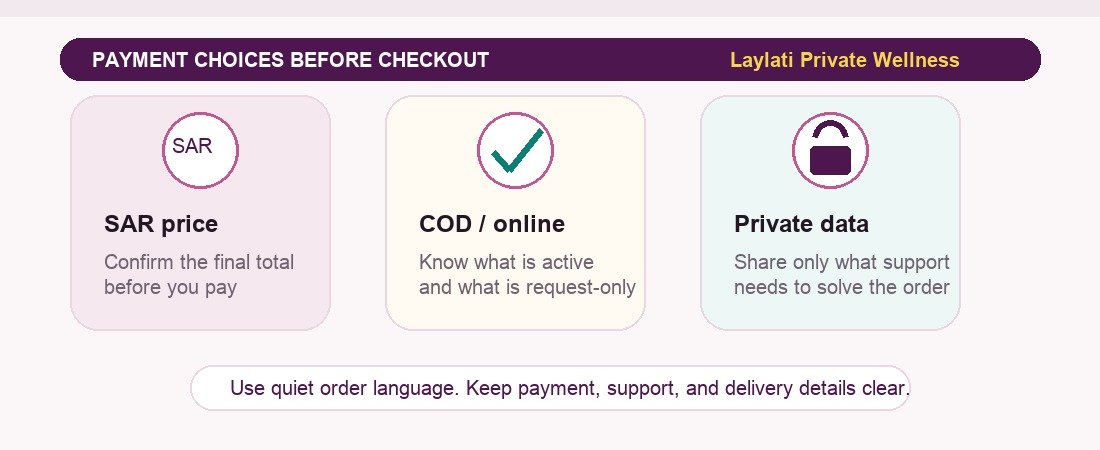
Start with the final SAR total
The first payment detail should be the least dramatic one: the final total in SAR.
Before checkout, the shopper should be able to see:
- Product price.
- Any sale price or bundle discount.
- Delivery charge, if known.
- Whether cash collection or manual confirmation changes the process.
- What happens if support needs to confirm an address, payment note, or delivery area.
This is especially important for a category where many customers will not want a long back-and-forth after payment. A clear SAR total reduces the need for extra messages, and fewer extra messages usually means a more private order.
Laylati already uses SAR pricing across the product and cart surfaces. The next step is to keep payment language as plain as the price: no vague “secure and easy” claim without the basic order facts beside it.
Do not treat every payment method the same
Different payment methods create different questions for a private order.
An online card or wallet payment raises questions about security, confirmation wording, and whether the customer receives a neutral receipt. Cash on delivery raises questions about courier handling, failed delivery, and who collects payment. A crypto request raises a different set of questions again: availability, confirmation time, refund route, and support review.
A private wellness store should not collapse those into one cheerful line. It should separate the choices:
- Online payment: show the final total, order reference, and confirmation language.
- Cash on delivery: explain whether COD is available for the shopper’s area and how delivery will be confirmed.
- Manual or crypto request: make clear that support must confirm the route before the order is treated as paid.
For Laylati, this distinction matters right now. Crypto collection is a candidate route being prepared, not something the store should describe as automatically live until the signed gateway, callback, order status handling, and test order flow have been verified. Payment copy should reflect that operational reality.
Payment trust is also fraud prevention
Payment clarity protects both sides of the order.
The Merchant Risk Council’s 2026 Global eCommerce Payments and Fraud Report frames payment acceptance and fraud prevention as connected operating problems, not separate back-office issues. Its 2026 report covers payment acceptance, decline patterns, fraud strategies, post-purchase abuse, and refund or policy misuse. Visa Acceptance Solutions’ summary of the same annual report also points to tokenization, first-party misuse, and infrastructure challenges as live concerns for ecommerce merchants.
A small private wellness store does not need to turn checkout into a fraud lecture. But it does need to avoid ambiguity. When payment instructions are vague, support has to solve the missing detail later. That creates extra messages, extra personal data, and more room for disputes.
A better payment page tells the shopper what information is needed, what should not be sent, and when support will follow up.
Ask for less information, not more
Payment support should not ask the customer to repeat sensitive product details unless there is a practical reason.
In most cases, the order number, payment method, and preferred contact route should be enough to start. A support prompt that asks for product names, screenshots, personal explanations, or unnecessary ID details can make a private order feel exposed.
SDAIA’s public guide to Saudi personal data protection puts practical emphasis on transparency, purpose limitation, collecting only necessary personal data, accuracy, storage limits, confidentiality, and accountability. For Laylati, the operational translation is simple: collect the information required to process the order, explain why it is needed, and avoid turning support chat into a second checkout form.
Good payment support language sounds like this:
Please send your order number and payment method. We will review the payment status privately.
Arabic can stay just as neutral:
يرجى إرسال رقم الطلب وطريقة الدفع. سنراجع حالة الدفع بسرية.
That is enough to move the issue forward without asking the customer to describe the product in a public or shared-phone context.
COD needs its own wording
Cash on delivery can be useful in trust-sensitive markets, but it is not a magic privacy feature. It changes the point of risk.
With COD, the customer may feel safer because payment happens at delivery. At the same time, the store has to manage order confirmation, failed delivery, courier timing, and neutral parcel handling more carefully. The payment page should not promise more than the operations team can actually deliver.
If COD is offered or being reviewed, the wording should answer four questions before checkout:
- Is COD available for this city or delivery area?
- Will the parcel remain neutral on the outside?
- How will delivery timing be confirmed?
- What happens if the courier cannot complete delivery?
This connects directly to Laylati’s existing guidance on discreet packaging, shipping and delivery, and neutral delivery messages. Payment is not a standalone promise. It is part of the same private order chain.
Crypto should be described as a confirmed route, not a slogan
Crypto payment can appeal to some shoppers because it feels separate from ordinary card statements. That does not make it automatically simpler.
For a real ecommerce order, the store must still know how to match the payment to the order, confirm the network and amount, handle time windows, manage underpayment or overpayment, and decide what happens if the order is cancelled or refunded. A crypto badge on a payment page is not enough.
Until those flows are live and tested, the safer customer-facing wording is:
Crypto payment requests are reviewed by private support before confirmation.
That line is not less commercial. It is more honest. It tells the shopper there is a route to ask, while protecting the store from claiming automated collection before the system is ready.
The receipt should stay neutral
A customer may trust the payment form but still worry about the receipt, notification, or order message. That concern is reasonable in this category.
The payment flow should make three pieces of language neutral:
- The order confirmation message.
- The customer-support follow-up.
- The parcel or delivery update.
Neutral does not mean unclear. It means the message identifies the order without broadcasting the product type. “Your Laylati order has been received” is better than a line that repeats the category or product format in a notification preview.
This is where Laylati’s bilingual support work matters. English and Arabic confirmation language should be consistent, calm, and short enough for mobile screens.
A payment checklist before placing the order
Before paying for a private wellness order, shoppers should check more than the button label.
- Is the final total shown in SAR?
- Is the available payment route clear, not implied?
- If COD is involved, is the delivery process explained?
- If crypto is requested, is support confirmation required before payment is treated as complete?
- Does the store explain how payment and order messages will appear?
- Does support ask only for the information needed to process the order?
- Are the privacy policy and delivery pages easy to find before checkout?
If these answers are missing, the issue is not just copywriting. It is a conversion risk.
How Laylati should keep improving this layer
Laylati’s checkout language should stay practical as the store adds payment routes. Each new option needs a short customer-facing explanation, a private support script, and a tested order-status path. The payment page should not become a list of logos. It should become a quiet decision surface.
For shoppers, the simple rule is this: pay only after the store has made the total, route, confirmation message, and support path clear. For Laylati, the operating rule is just as simple: no payment wording should promise a process that has not been tested end to end.
If you are unsure which payment route fits your order, contact private support before checkout. A short question before payment is better than a long explanation after it.