
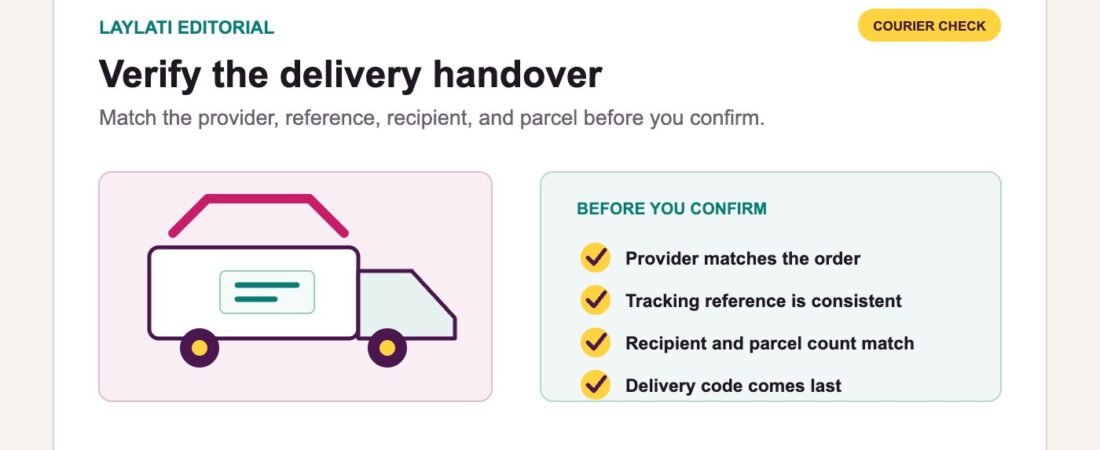
A private delivery should not become anonymous at the last metre. The shopper does not need a courier’s employment file, but the handover should still connect to a named store, a traceable delivery company, an order reference, and an official support channel.
That distinction matters in Saudi Arabia. On 23 June 2026, Saudi newspaper Okaz reported a renewed Transport General Authority push against ecommerce deliveries arranged through unlicensed transport services. The practical lesson for a shopper is not to conduct a roadside licensing investigation. It is to keep the delivery inside a chain that can be checked and documented.
Start with the seller’s order record
Before reacting to a call, WhatsApp message, or SMS, open the store directly and find the order confirmation. Note the order number, delivery city, expected parcel count, carrier name if shown, and the tracking reference. The courier’s details should make sense beside that record.
A legitimate delivery can still arrive through a subcontracted driver, and a branded uniform does not prove that every message is genuine. Conversely, an unfamiliar vehicle does not by itself prove a problem. The stronger check is whether the person at the door can be connected to the order through the seller’s or carrier’s official system.
If the carrier name is missing from the order record, use the store’s official order-support page before sharing additional information. Ask which delivery company has the parcel and which tracking reference should appear. Do not resolve the uncertainty through the unexpected message itself.
Use the TGA directory as an official starting point
The Transport General Authority maintains a public page for licensed parcel companies. It is a more reliable starting point than a search advertisement, a copied logo, or a social-media profile. Search for the company name exactly as it appears in the order record, then continue through the provider’s own website or application.
The directory is a provider-level check, not proof that a particular caller is the assigned driver. A shopper still needs to match the tracking reference and handover details. If the company name cannot be reconciled with the seller’s record, pause and contact the seller through a channel opened independently.
Saudi postal customer-rights rules also require licensed providers to publish contact and tracking routes, complaint procedures, service limits, and methods for handling undelivered items. Those published routes are useful because they leave a record. A personal number that cannot be connected to the carrier’s system does not offer the same trail.
Match four details before the handover
Four ordinary details usually provide enough context without exposing a private purchase: the recipient name, delivery area, tracking reference, and parcel count. If the order confirmation shows two parcels and the driver has one, ask whether the shipment was split before accepting a verbal explanation.
Do not ask the driver to describe the product. Neutral outer packaging should not display sensitive contents, and the courier may not know what is inside. The useful question is whether the label, tracking number, and delivery route belong to the order you are expecting.
For orders using a National Address, compare the saved delivery information with the order record rather than dictating a full address to an unknown caller. Laylati’s Saudi National Address checklist explains which fields should be confirmed before dispatch and which corrections should go through support.
Keep the conversation limited to delivery data
A courier may reasonably need help locating the building or confirming that the recipient is available. That does not require a banking password, card verification code, account password, or a detailed description of the purchase. It should not require installing an application from a message link.
Use the minimum information needed to complete the route. If a caller asks for a new payment, address fee, or identity document that does not appear in the order, stop and verify the request through the seller and carrier separately. The delivery-message verification guide covers how to handle an unexpected link or redelivery request.
For a private order, neutral language is enough: order number, parcel, delivery, building, gate, support, and tracking reference. Product-category wording does not belong in a lobby call, public message preview, or shared household chat.
Check the parcel before sharing the delivery code
The provider check and the parcel check are separate. A correctly identified courier can still bring the wrong, incomplete, or visibly damaged parcel. Match the label and count, then inspect the outer box before closing the handover.
Saudi Ministry of Commerce guidance says the delivery code is an acknowledgement that the products were received in an orderly and sound condition. Delivery procedures vary by service, but the sequence is sensible: identify the parcel, review its visible condition, then provide the code required to complete delivery.
If the parcel is wet, open, retaped, crushed, punctured, or addressed to somebody else, use the damaged or opened parcel checklist before signing or discarding packaging.
Use official channels when the delivery changes
A route change, substitute driver, delay, or failed attempt can be genuine. The change should still be visible in the carrier’s official tracking record or confirmable by the seller. Ask for the event to be recorded rather than accepting an off-system promise.
Keep screenshots of the official tracking page, the time of the call, the number used, and any case reference. Avoid posting the shipping label publicly; it can expose a name, phone number, address, barcode, and tracking number. Share that evidence only with the seller, carrier, or appropriate official channel.
If support is needed, start with the store and delivery company because each controls a different part of the record. The seller can confirm dispatch and packed items; the provider can confirm scans, driver assignment, attempts, and handover. Use the current complaint route published by the provider and retain its reference number.
What a privacy-conscious store should make clear
A store cannot eliminate every last-mile problem, but it can reduce uncertainty. Before checkout or dispatch, it should state the delivery area, expected timing or range, neutral packaging standard, support channel, and any information the courier may need. After dispatch, the carrier name and tracking route should be easy to find.
Laylati’s shipping and delivery page is the reference point for current store promises. If a message, caller, or handover detail conflicts with that page or the order confirmation, pause and use private support rather than exposing more data at the door.
The useful standard is simple: the store, carrier, tracking reference, recipient details, and parcel should tell one consistent story. When they do not, the right next step is verification, not speed.
Sources
- Okaz, report on ecommerce delivery arrangements and licensed transport, 23 June 2026
- Transport General Authority, Parcel Companies directory
- Transport General Authority, Rules for Protection of Rights of Postal Services Customer
- Transport General Authority, official notice on unlicensed delivery applications
- Saudi Ministry of Commerce, delivery-code and shipment-condition guidance