
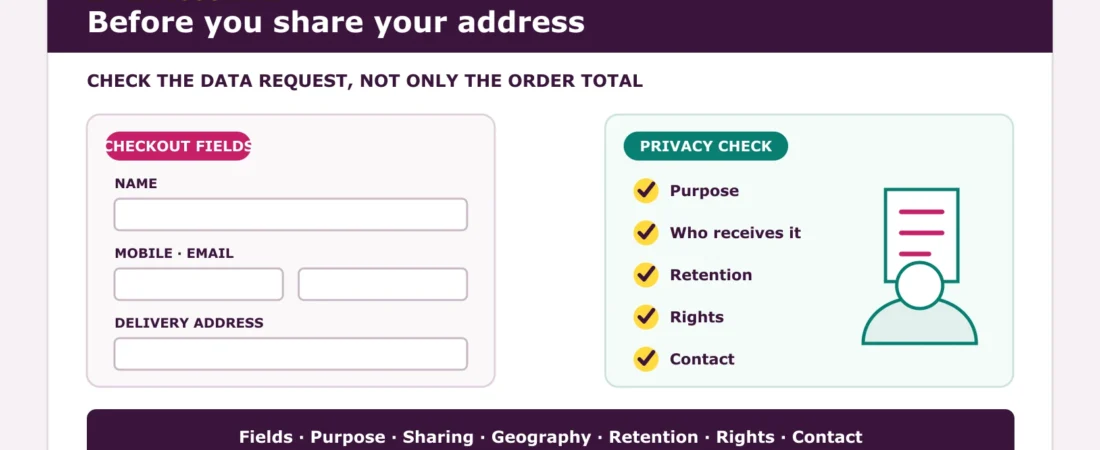
An address field looks routine until you count what sits beside it: a full name, mobile number, email address, city, district, building details, payment status, delivery instructions, and an order record. Together, those details can identify a person, locate a home, and describe a purchase.
That is why a privacy notice belongs in the buying decision, not in a footer that shoppers discover after payment. Before entering personal information, a shopper should be able to understand what the store asks for, why each detail is needed, who may receive it, and where to ask a privacy question.
This checklist turns current Saudi privacy and ecommerce guidance into eight practical checks. It is consumer education, not legal advice or a declaration that any store has completed a regulatory audit.
Why this deserves a checkout check in 2026
Saudi Arabia’s National Cybersecurity Authority launched its Shop Safely campaign with the Ministry of Commerce and the E-Commerce Council in February 2026. The campaign focuses on safer dealings with ecommerce platforms and protection from changing cyber risks. A separate Ministry of Commerce evaluation of ecommerce stores includes consumer-data and privacy policies, customer contact routes, shipping policies, returns, complaints, and site security among the criteria it examines.
SDAIA’s privacy-policy guideline is more specific about the notice itself. It says a privacy policy should explain the personal data collected, the purpose and method of processing, disclosure recipients, geographic scope, retention and destruction, individual rights, and a contact route. It also recommends presenting the policy in clear, accessible language when data is collected.
For a private order, clarity is especially valuable. The goal is not to eliminate the information needed to fulfil an order. It is to avoid collecting or sharing information without a visible reason.
1. List every field before you complete it
Read the entire checkout form before typing. A normal order may need a name, mobile number, email address, delivery address, city, postcode, and payment choice. Account creation may add a password, saved address, order history, or communication preferences.
Separate the fields into four groups: identity, contact, delivery, and payment. Then note anything that does not fit. A request for an identification number, date of birth, occupation, unrelated household detail, or a second phone number deserves an explanation before it is supplied.
Do not judge a field only by whether it is common on other sites. The useful question is whether it is necessary for this order and whether the store explains its purpose.
2. Match each requested detail to one clear purpose
A delivery address should support delivery. A mobile number may support courier contact or an order update. An email address may carry the order confirmation, receipt, or support reply. The purpose should be close enough to the field that a shopper does not have to guess.
Watch for broad phrases such as “improving services” when the form asks for detailed personal information. A broad purpose may be reasonable for aggregated analytics, but it does not explain every checkout field. The privacy notice should distinguish order fulfilment, fraud prevention, customer support, analytics, and marketing rather than compressing them into one sentence.
If a field has no visible relationship to ordering, payment, delivery, support, or a stated obligation, pause and ask why it is needed.
3. Distinguish required information from optional information
A required field should be marked clearly. Optional fields should not become mandatory because the form is poorly configured. Delivery notes, a second address line, account registration, and promotional consent may be useful in some situations, but they do not automatically belong to every purchase.
Guest checkout can reduce the amount of persistent account information a shopper creates, although the store still needs to retain an order record for fulfilment and support. A saved account can be convenient for repeat purchases, but the choice should be deliberate. Compare guest checkout and account use before saving addresses on a shared device.
Never place marketing consent inside a required acceptance box for completing an order. Essential service messages and optional promotions serve different purposes.
4. Check who receives order information
An ecommerce order often involves more than the storefront. Hosting providers may process site activity. A payment provider handles transaction information. A courier receives the details required for delivery. Support and email services may process communications. Analytics or advertising services may receive device, cookie, or event data when enabled.
The privacy notice should describe the categories of recipients and why information is disclosed to them. It does not need to turn into a directory of technical suppliers, but “trusted partners” without a purpose is not very informative.
For delivery, ask what the courier actually needs. A neutral parcel can carry the name, address, telephone number, and routing data required for handover without putting a sensitive product description on the label. Review Laylati’s discreet-packaging approach and shipping guidance separately from the privacy notice.
5. Look for the geographic scope of processing
A store may operate locally while using hosting, email, analytics, support, or payment infrastructure in another country. Local stock does not by itself show where customer data is stored or processed.
SDAIA’s guideline lists the geographic scope of processing among the elements a privacy policy should address. A shopper does not need to map every server. The notice should provide enough information to understand whether processing may occur outside Saudi Arabia and where to request further detail.
A missing explanation is a reason to ask a question, not evidence of a particular data route. Avoid drawing conclusions from the country code of a support number or the location shown in a browser speed test.
6. Find the retention and deletion explanation
“We keep data as long as necessary” is a starting point, not a complete operational explanation. Different records may need different periods. Order and payment records, fraud logs, support conversations, saved accounts, abandoned carts, and marketing lists do not all serve the same purpose.
Look for the criteria used to set retention periods and what happens when the information is no longer needed. The notice should also explain how a shopper can ask about deletion where applicable. Some records may need to remain for an order, dispute, accounting, security, or other stated reason even after marketing consent is withdrawn.
On your side, keep only the records needed to resolve the purchase: the order reference, total, promised delivery window, and relevant support messages. Avoid storing full payment details or unnecessary screenshots on a shared phone.
7. Separate order messages from marketing
An order confirmation, dispatch update, address question, failed-delivery notice, and refund message are part of servicing the transaction. A sale alert, product recommendation, abandoned-cart promotion, or recurring newsletter is marketing.
The privacy notice and consent controls should make that difference understandable. Declining optional marketing should not prevent necessary order updates. Agreeing to receive a receipt should not silently become permission for unrelated promotions.
For a private purchase, also check the wording and sender identity used in notifications. Laylati’s guide to neutral order confirmations explains how an update can remain useful without exposing the purchase on a lock screen or shared inbox.
8. Locate the privacy contact before payment
A usable privacy notice should identify a route for questions about access, correction, deletion, consent, or the way data is used. The route might be a dedicated privacy contact or a support channel that can direct the request correctly.
Test whether the page and contact route are easy to find before sharing information. Do not send identity documents, payment screenshots, or a full address in the first message unless the store explains why they are required and how they will be handled.
When a checkout field or data-use explanation is unclear, use private order support before payment. A short question should normally need only the field name, the checkout stage, and the explanation requested.
A two-minute privacy check
- Can you name every field the checkout requests?
- Does each field have a clear order, payment, delivery, support, security, or consent purpose?
- Are required and optional fields visibly different?
- Does the notice explain recipient categories and geographic scope?
- Can you find retention, deletion, rights, and contact information?
- Are essential order messages separated from optional marketing?
Read the current Laylati privacy notice alongside the checkout form. If a requested field or data-use explanation remains unclear, ask through private support before entering more information.
Sources
- SDAIA, Elaboration and Developing Privacy Policy Guideline
- National Cybersecurity Authority, 2026 safe online-shopping campaign announcement
- National Cybersecurity Authority, Shop Safely campaign resources
- Saudi Ministry of Commerce, ecommerce-store evaluation criteria
- Saudi Ministry of Commerce, Guide to Consumer Rights and Responsibilities