
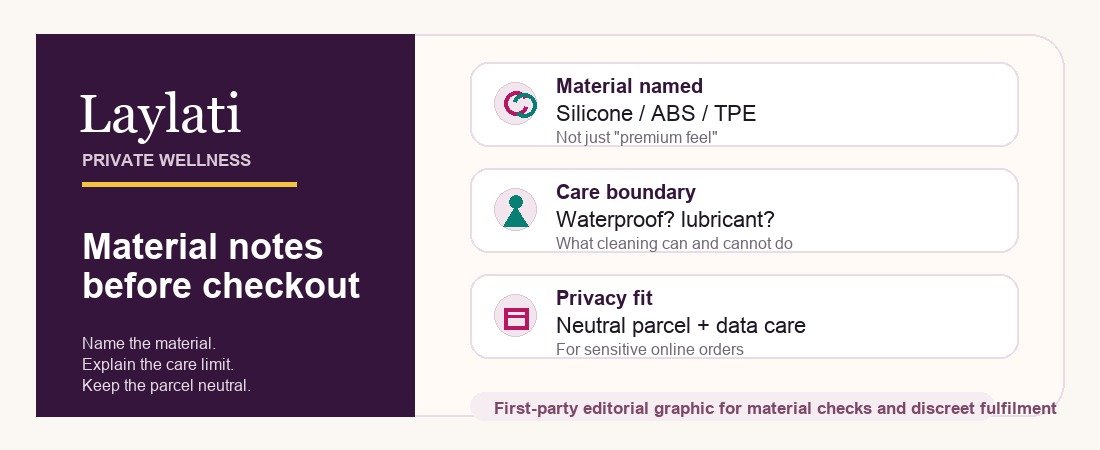
Material information is not a side detail. For a private wellness order, it is part of the trust contract between the store and the customer.
The product page has to answer a few plain questions before someone reaches checkout: What is the surface material? Which parts touch the body? How should it be cleaned and stored? Is the parcel neutral? What personal data is collected to deliver the order?
Those questions matter because vague product language is still common across consumer goods. Recent European Safety Gate notices are a useful reminder. In June 2026, the EU system published an alert for a consumer squeeze toy after testing found excessive phthalates in the plastic material. In 2025, another Safety Gate alert involving an intimate gadget focused on excessive DEHP in a USB cable component, not the main body-contact surface. Neither notice is about Laylati products, and neither is a Saudi regulatory decision. The point is narrower and more practical: material details should not be hidden behind soft words like premium, silky, or luxury.
For shoppers in Saudi Arabia and the wider GCC, product transparency also sits next to privacy. Private wellness retail is not only about the object inside the box. It is about what the store says, what it does not say, how it handles checkout data, and whether delivery feels neutral from cart to doorstep.
Start With The Exact Material Line
A good product page names the material in ordinary language. It should not stop at a mood phrase.
If a product is listed as silicone, the page should make clear which surface is silicone and whether there are separate parts made from ABS, metal, textile, cable material, or other components. If a product is listed as ABS, the page should explain whether that is the outer shell, a handle, a control panel, or the main contact surface. If a soft material such as TPE is used, the page should be especially clear about care, storage, and replacement expectations.
The exact wording matters because customers cannot inspect the product in-store. They are relying on the product page to do the work that touch, smell, packaging labels, and sales staff might do in a physical retail setting.
For Laylati, that affects every core category, from realistic forms and torso series to pumps and accessories and starter sets. A starter item should not be less transparent just because it is an entry-level purchase.
Separate The Contact Surface From The Hardware
One useful lesson from product-safety alerts is that the risk area is not always the obvious part. A notice can involve a cable, a coating, a small component, packaging, or a flexible plastic section rather than the main product body.
That is why a strong product page separates the parts:
- body-contact surface
- handle or shell
- cable or charging area
- storage bag or case
- accessories included in the set
This does not need to become a chemistry lesson. It needs to be readable and specific. A line such as “main surface: silicone; shell: ABS; cable: PVC-free charging cable” is more useful than “luxury material” because it gives the shopper something concrete to evaluate.
Treat Care Instructions As Material Information
Cleaning advice should match the material. A care note that says “wash after use” is too thin for a private wellness product.
The page should explain whether the item is waterproof or splash-resistant, whether a charging port needs to stay dry, whether the product should be dried before storage, and whether the product should be stored separately from other items. It should also avoid broad promises that the store cannot support.
For a fuller home-care checklist, Laylati has a separate guide on cleaning, drying, and storing private wellness products. The short version is simple: care instructions are part of material transparency. If the material is soft, textured, motorized, rechargeable, or part of a set, the care note should be more detailed, not less.
Be Careful With “Medical Grade” Claims
“Medical grade” is one of the most overused phrases in intimate wellness retail. It should only appear when the supplier can support it with documentation that matches the actual product and material.
For most shoppers, a clearer page is better than a louder page. It is more useful to know the named material, the product finish, the care limits, and what is included in the box than to read a broad claim that sounds impressive but cannot be checked.
The same applies to “phthalate-free”, “BPA-free”, “non-porous”, and similar terms. These phrases may be useful when documented. They become weak when they are pasted across a catalog without proof or without saying which material or component they describe.
Privacy Is Part Of The Product Page
In Saudi-facing private ecommerce, material clarity and privacy clarity belong together.
Saudi Arabia’s official data protection framework is built around personal data rights and controller obligations. For a private wellness customer, that translates into everyday questions: why does the store need this phone number, what appears on the package, what name appears in messages, and how much account information is required to place an order?
That is why a product page should link naturally to the store’s discreet packaging page and privacy policy. These links are not decoration. They help the customer judge whether the store understands the sensitivity of the purchase.
A Practical Checklist Before Checkout
Before placing a private wellness order, read the page with these questions in mind:
- Does the page name the main material?
- Does it separate the contact surface from handles, shells, cables, or accessories?
- Does it explain basic cleaning and drying limits?
- Does it say whether the item is waterproof, splash-resistant, or dry-use only?
- Does it explain how the item should be stored?
- Does the store describe neutral packaging and delivery communication?
- Does the privacy policy explain how order and contact data are handled?
- If the product is a set, are the materials listed for each included item?
If the answer is unclear, ask before ordering. A serious private wellness store should be able to explain material, care, and fulfilment basics without making the customer feel exposed.
The Laylati Standard
Laylati’s product pages should keep improving in this direction: clearer material notes, better category guidance, cleaner product photography, and neutral delivery language that respects the customer’s privacy.
For now, use the category pages to compare formats, read the care guide before first use, and contact the store if a material or care detail needs confirmation. In private wellness retail, confidence comes from quiet specifics. The better the product page, the less the customer has to guess.
Sources and Further Reading
- European Commission Safety Gate, alert SR/01596/26, published June 2026: https://ec.europa.eu/safety-gate-alerts/screen/webReport/alertDetail/10099178
- European Commission Safety Gate, alert SR/01651/25, published April 2025: https://ec.europa.eu/safety-gate-alerts/screen/webReport/alertDetail/10093980?origin=PDF
- U.S. Consumer Product Safety Commission, Phthalates Business Guidance: https://www.cpsc.gov/Business–Manufacturing/Business-Education/Business-Guidance/Phthalates
- Saudi Data and AI Authority, Data Protection Law: https://sdaia.gov.sa/en/Research/Pages/DataProtection.aspx