
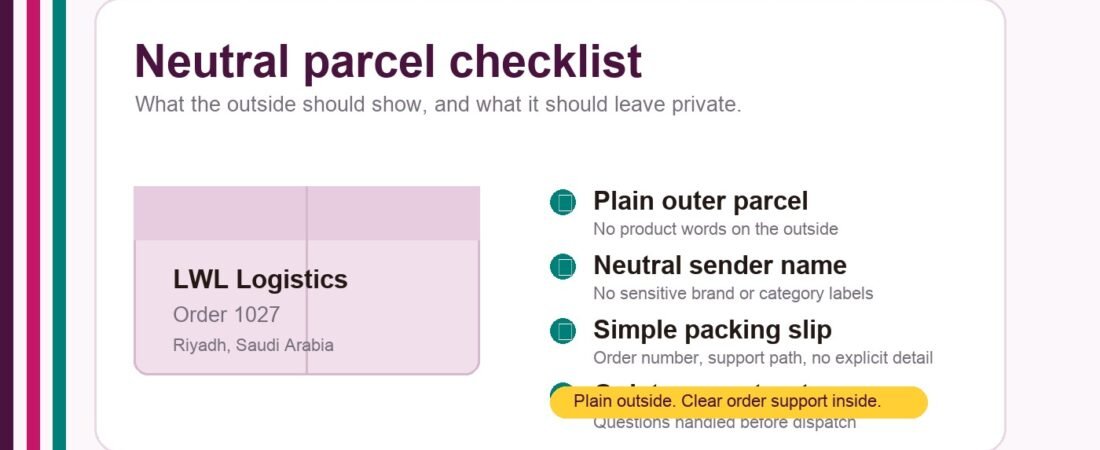
A private parcel should not announce itself before the customer opens it. That is the simple test. The outside should carry enough information for delivery to work, and no more: a neutral sender name, a correct address label, a tracking reference, and ordinary courier handling.
For private wellness orders, packaging is not decoration. It is part of the service. A plain outer parcel helps the customer accept the delivery without having to explain the purchase to a building guard, family member, courier desk, or neighbor. The label should solve the logistics problem. It should not create a privacy problem.
Delivery trust is now part of the sale
DHL’s 2026 ecommerce trend work is blunt about one thing: shoppers judge online stores by delivery and returns, not only by product choice. Its current report says trust and choice around delivery and returns are central to whether shoppers complete the order, and it notes premium delivery-and-return expectations in markets including Saudi Arabia and the UAE.
That matters for Laylati because the private part of the order does not begin at checkout. It continues through dispatch, parcel handling, tracking updates, customer support, and the handoff at the door. A store can have a careful product page and still lose trust if the parcel label says too much.
What the outside of the parcel should say
The outer packaging should be plain enough to look ordinary in a delivery stack. Shippo’s current discreet-shipping guidance describes discreet shipping as sending a package without revealing what is inside or who sent it, using plain packaging, neutral return addresses, and carrier features where appropriate. Shopify’s discreet packaging guidance makes the same practical point: plain boxes, plain envelopes, generic mailers, and minimal labels help conceal the contents.
For a Laylati order, the outside of the parcel should usually show:
- a neutral sender or logistics name, not a sensitive category term;
- the customer’s delivery name and address;
- a courier tracking barcode or reference;
- normal handling details required by the courier;
- no product name, product image, category description, or intimate wording.
The wording should be dull on purpose. A private parcel is successful when nobody notices it.
What should not appear on the outside
Some wording looks harmless to the store team but reads very differently at the customer’s door. Avoid product names, model labels, category names, body-part language, bold promotional stickers, or any return-address language that points to a sensitive purchase. Even a small printed note can create the exact situation discreet delivery is meant to avoid.
The same caution applies to customs-style descriptions, packing notes, or courier remarks. If a required field must exist for logistics, make it functional and neutral. Do not use the outside of the parcel as a marketing surface.
The packing slip needs a different standard
The packing slip sits inside the parcel, so it can be more useful than the outer label. But useful does not mean careless. A good packing slip confirms the order number, price, support path, and return boundary. It should help the customer check the order without forcing sensitive wording into a document that may be seen by someone else in the household.
If a product number is enough, use the product number. If support needs more detail, keep that detail in the order record and private support channel, not on a loud insert. The customer should be able to ask a clear question without repeating private details in a public comment, courier note, or payment message.
Neutral packaging is not a promise to hide poor information
Discreet packaging should never be used to make the product page vague. The opposite is true. The public product page should be clear about price, product number, category, photos, care notes, delivery route, and return limits before payment. The parcel should be neutral because the website already did the explaining.
This is where private wellness ecommerce needs discipline. The site should provide enough information for a calm decision, then ship the order in a way that does not expose the decision to outsiders.
What customers should check before dispatch
Before a private order leaves the store, check the practical details that affect both privacy and delivery: the correct city, address, phone number, product number, price in SAR, payment method, and delivery notes. If anything needs correction, handle it before dispatch. A neutral parcel cannot fix a wrong address after the courier has it.
The useful internal links are the same ones a shopper should see before checkout: discreet packaging, shipping and delivery, returns and refunds, payment methods, and private support.
A simple Laylati parcel standard
Laylati’s parcel language should follow one rule: plain outside, clear inside, quiet support if something needs to be handled. The outer parcel should look like ordinary ecommerce. The support path should be easy to find. The product decision should stay between the customer and the store.
That is not only a privacy preference. It is a conversion standard. Shoppers who understand how a parcel will look, what the label will say, and how support will handle questions have fewer reasons to hesitate before checkout.
Before placing a Laylati order, review the packaging and delivery pages, then ask private support any dispatch question before payment. A quiet parcel works best when the order details are already correct.