
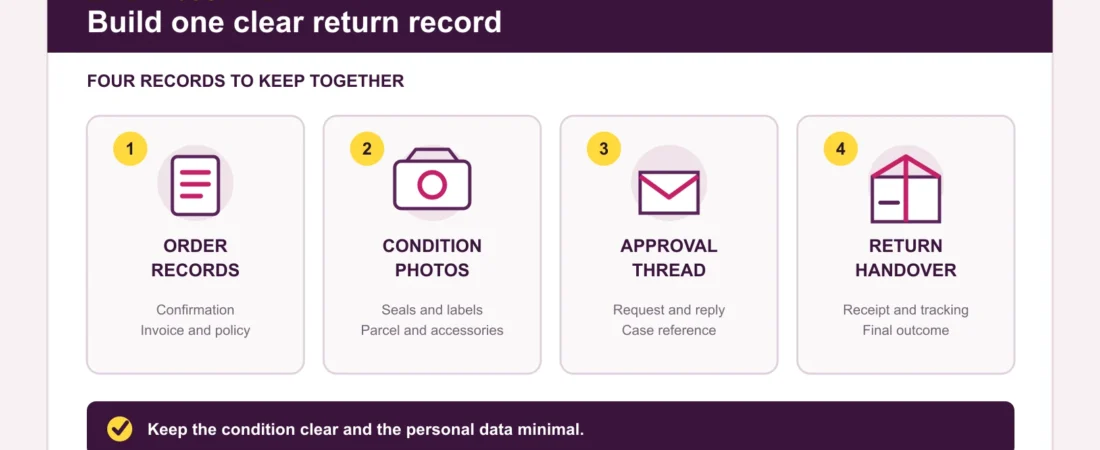
A return request is easier to assess when the condition of the order is documented before the parcel leaves your hands. The useful file is not a folder of random screenshots. It is a short sequence that shows what was ordered, what arrived, what condition it was in, what the store agreed to do, and what happened after handover.
This is a timely retail issue in Saudi Arabia. In its consumer bulletin for the second quarter of 2026, the Ministry of Commerce said ecommerce-store reports and reports about failure to follow exchange and return policies were among the leading categories it handled. That does not mean every purchase is returnable. It does show why shoppers and stores need a clear record of the policy, product condition, request, and outcome.
The checklist below is practical guidance, not legal advice. Return eligibility depends on the live store policy, the item, its condition, hygiene or safety restrictions, and the facts of the order. For private wellness products in particular, do not open a seal merely to create a better photograph.
1. Save the policy that applies before you start the return
Open the store’s current returns page and the product page. Save the sections that deal with the return window, excluded items, hygiene seals, unopened packaging, faults, delivery damage, accessories, and the process for obtaining approval. Include the page address and date in the capture.
Do this before packing the order, because the first question is not “Which courier should I use?” It is “Which route does this order qualify for?” A change-of-mind request, a wrong item, visible delivery damage, and a confirmed fault may follow different processes. Do not select the reason that sounds most favourable; select the one that matches the record.
Laylati’s guide to return and refund boundaries for private wellness orders explains why product condition and hygiene status should be checked before a return is promised. The live returns and refunds page remains the operational reference for a Laylati order.
2. Keep the order confirmation and invoice intact
Save the original order confirmation and electronic invoice rather than copying only the product name into a new message. The record should show the order reference, date, item, quantity, price, discount if any, delivery charge, payment method, and destination details relevant to the order.
Share only what the return process needs. A support team usually does not need a full bank statement, unrelated account transactions, or photographs of identity documents just to locate an order. If a document contains unnecessary personal information, keep the original privately and send a redacted copy.
The Ministry of Commerce consumer guide describes the electronic invoice as a key ecommerce record. Laylati’s separate guide to order confirmations and electronic invoices shows which fields are worth comparing before contacting support.
3. Photograph seals, accessories, and identifiers before repacking
Take a small set of clear photographs in neutral light. Start with the full item and its retail packaging. Then capture any hygiene or tamper seal, included cable or accessory, instruction material, model label, batch or serial reference if present, and the condition of the packaging.
The aim is to show completeness and condition, not to make the item look attractive. Keep the item on a plain surface and avoid including faces, reflections, bedroom details, location documents, or unrelated possessions. If the product has a sensitive form, frame only the detail needed to identify its condition.
Do not remove a label, break a seal, charge, wash, or test an item just to produce evidence unless the store has specifically asked you to perform that step and it is safe to do so. The act of “checking” can change the condition that the return process needs to assess.
4. Record the outer parcel separately from the product
The shipping carton or mailing bag tells a different part of the story. Photograph all sides before discarding it, including visible crushing, tears, moisture, opened tape, resealing, or a damaged corner. Capture the shipping label for your private record, then mask your name, mobile number, and address in any copy sent beyond the official support channel.
If the parcel was already damaged or open at delivery, record that before opening the inner packaging. Note the delivery time and whether the courier recorded a handover exception. The damaged or opened parcel checklist covers this sequence in more detail.
Do not combine outer-package damage with a product fault unless both are actually present. A crushed carton, a missing accessory, a wrong item, and a device that does not operate are four different facts.
5. Show the issue in context, not through ten near-identical close-ups
When the return concerns a visible problem or a mismatch, use three levels of evidence:
- one overview showing the complete item or parcel;
- one medium view locating the issue; and
- one close view showing the detail clearly.
If the wrong item arrived, place the received label or model reference beside the corresponding line on the order confirmation. If something is missing, photograph everything that was inside the package together. If a short video is genuinely necessary to show a function or sound, keep it brief and avoid including personal audio or the surrounding room.
Describe what is observable. “The cable was not in the sealed accessory compartment” is more useful than “the package was terrible.” Do not claim a technical cause that has not been diagnosed.
6. Put the request and the store’s response in one thread
Send one concise request through the store’s published support route. Include the order reference, the reason category, the date the issue was noticed, a short description, and a small selection of the clearest files. Ask for the next step: approval, additional evidence, a return reference, collection instructions, or another stated resolution.
Keep the reply, timestamp, case number, and any conditions attached to the approval. “Request received,” “return approved,” “parcel collected,” “inspection completed,” and “refund initiated” are separate events. A support acknowledgement is not automatically a return approval.
Continue in the same thread where possible. Starting several chats with different summaries makes it harder to see which instruction is current and may expose more personal information than necessary.
7. Do not hand over the parcel without a return reference
Before the item leaves you, save the return authorisation or case reference, the approved address or collection instruction, the carrier name, the parcel count, and any packaging requirement. Photograph the sealed return parcel after the return label is attached, while masking personal details in any shared copy.
At handover, keep the carrier receipt or collection confirmation and the return tracking number. Open the tracking route through the carrier’s official site and save the first acceptance scan. A label created on screen is not the same as a parcel accepted into the carrier network.
The Transport General Authority’s published postal-customer rules require providers to publish procedures concerning returns, undelivered items, address changes, tracking, complaints, and related charges. Use the current procedure of the assigned carrier rather than sending the parcel to an address found in an old message or public comment.
8. Close the file only when the outcome is visible
Keep the record until the store and payment outcome are complete. Save the inspection result, approved refund or replacement details, amount, currency, method, reference, and stated processing period. Then compare that record with the amount that actually appears through the payment provider.
Do not confuse “refund initiated” with “funds received.” If a partial amount is expected because of an agreed fee or excluded charge, make sure the reason is stated in the store’s response. If a replacement is sent, keep the original order, return tracking, and replacement tracking together.
The evidence file can be compact: one policy capture, the order documents, four to eight condition photographs, one support thread, one return receipt, and the final outcome. More files do not automatically make the case clearer.
A private return file in two minutes
- Save the live policy and product-page conditions before changing the item.
- Keep the order confirmation and invoice; redact unrelated personal data in shared copies.
- Photograph the item, seals, accessories, identifiers, and packaging in neutral light.
- Record the outer parcel and delivery condition separately.
- Use an overview, a locating view, and a close view for any visible issue.
- Keep the request, response, approval, and case reference in one thread.
- Save the sealed return parcel, handover receipt, and first carrier scan.
- Keep the file until the refund, replacement, or other agreed outcome is complete.
Before changing or repacking a Laylati order, review the live returns and refunds information. If the correct route is unclear, use private order support with the order reference and a short description of the condition.
Sources
- Saudi Ministry of Commerce, Consumer Sector Bulletin for Q2 2026, including ecommerce and exchange/return-policy reports, published 22 July 2026
- Saudi Ministry of Commerce, consumer rights and ecommerce exchange/return guidance
- Saudi Ministry of Commerce, Guide to Consumer Rights and Responsibilities, ecommerce records and electronic invoices
- Transport General Authority, Rules for Protection of Rights of Postal Services Customer