
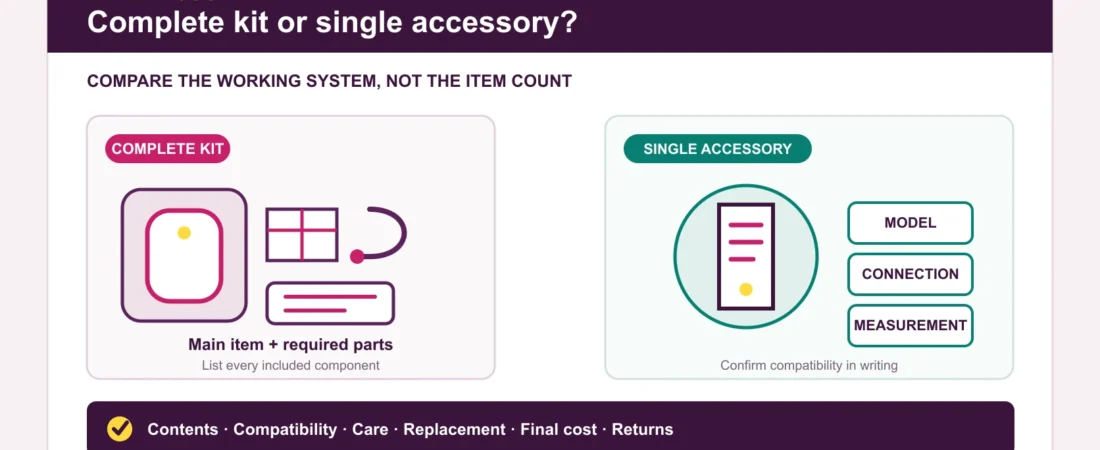
A complete kit can look like the obvious bargain: one box, several components, and a price lower than buying every piece separately. But the useful comparison is not “How many things are in the box?” It is “How many of these things fit the product, the routine, and the way I will actually store and maintain it?”
Bundle design is receiving fresh attention in retail research. A study published online in May 2026 in the International Journal of Research in Marketing examines how retailers decide which complementary products belong in a prepacked bundle and how those bundles sit beside individual products. For shoppers, the practical lesson is simpler: evaluate each component as part of one working system, not as a row of bonus items.
This checklist is designed for private wellness kits and accessories, including the current Pumps & Accessories collection. It does not confirm that one accessory fits another. Compatibility must come from the live product information or direct written support.
1. Start with the one job the purchase needs to do
Write down the purpose of the purchase in one sentence before comparing products. For example: replace a worn accessory, add one compatible component to an existing item, or buy a complete first-use setup. If the sentence contains three different needs, separate them before judging the bundle.
A full kit is useful when its components are designed to work together and the buyer needs most of them. A single accessory is often the cleaner choice when the main product is already owned and only one confirmed-compatible part is missing. Buying a second main unit to obtain one small component is not automatically better value.
Do not let the product title define the job for you. “Starter,” “complete,” “premium,” and “value” are merchandising labels. The included-parts list and the compatibility notes are the evidence.
2. Turn the contents into a written inventory
Copy every included item from the product page into a short list. Separate the main item, functional accessories, charging or connection parts, storage, instructions, samples, and promotional extras. If the image shows something that the contents list does not name, do not assume it is included.
Then mark each line as needed, already owned, optional, or unclear. This removes the visual advantage of a crowded product image. Six pictured pieces may amount to one main item, two required connectors, one duplicate cable, one storage bag, and one promotional extra. That is different from six independent products.
The Saudi Ministry of Commerce says online sellers should disclose the basic characteristics of what is being sold, along with the total price and the applicable payment, delivery, and warranty terms. If the contents are unclear, ask before checkout rather than trying to settle the question from the photograph.
3. Check compatibility line by line
Compatibility is a set of details, not a general impression. Depending on the product, the relevant fields may include:
- model name or model number;
- connection type and attachment method;
- internal and external measurements;
- power, charging, cable, or adapter requirements;
- operating mode or control-system requirements; and
- any brand-specific or generation-specific limitation.
Match those fields against the item already owned. Similar shape, colour, or naming is not proof. A component can appear to fit while using a different connector, measurement, generation, or power requirement.
Laylati’s guide to product details to check before buying explains how to separate stated specifications from assumptions. The individual pages for the No. 9 Pump Kit, No. 10 Smart Sleeve, and No. 11 Sleeve Extender should be compared independently; their presence in one category does not by itself establish interchangeability.
4. Count usable components, not total components
Once compatibility is confirmed, calculate how many included items will actually be used. Give no extra value to a duplicate part unless it solves a real replacement or travel need. Give limited value to a sample-size extra unless its quantity and purpose are clear.
A simple comparison works better than a percentage claim:
| Question | Complete kit | Single accessory |
|---|---|---|
| Needed items included | List the parts you will use | Confirm it solves the missing-part need |
| Duplicate items | Mark what is already owned | Usually lower, but check required connectors |
| Compatibility risk | Check the system as a whole | Check the accessory against the owned item |
| Storage and care | More components to separate and maintain | Usually simpler, but not always |
Do not invent a “per item” price by dividing the box price by everything pictured. A required cable, instruction card, storage bag, and main product do not carry equal value. Compare the cost of the needed setup, not an artificial average.
5. Read the care instructions for every material and component
A kit can contain parts with different cleaning, drying, charging, and storage requirements. One component may be washable while another contains electronics. One may need to be detached before cleaning. A pouch may be intended for storage only after every part is fully dry.
Use the instructions supplied for the exact model. Do not apply a general cleaning method to the whole box, and do not accept an undefined phrase such as “body-safe” as a substitute for a named material and care guidance. If the product is rechargeable, use the stated cable and adapter requirements and review the rechargeable-device charging checklist before first use.
Also ask whether the components need separate storage. A kit that saves money at checkout can still be inconvenient if the pieces cannot be dried, protected, and stored in the space available.
6. Check the replacement path before choosing the bundle
Find out which parts are consumable, replaceable, or sold separately. Check whether the exact connector or accessory can be reordered, whether model names are stable, and what information support needs to identify a replacement.
This matters because one missing or damaged accessory can prevent the rest of a system from being used. A bundle has stronger long-term value when the important parts have a clear replacement path. A single accessory has stronger value when it extends the useful life of something already owned without adding an unnecessary second system.
Keep the product page, order confirmation, and model information after purchase. They are more useful for a future replacement question than a cropped product photograph.
7. Compare the final checkout cost, not the badge
Write down the kit price, the single-accessory price, any other required component, delivery charge, tax treatment if shown, and the final amount at checkout. Compare both routes using the same date and currency.
A “save” badge is not the calculation. Saudi Ministry of Commerce guidance for commercial discounts says the before-and-after price and discount information should be clear, and shoppers should retain the ability to choose goods without being forced into a promotional offer. If a kit is useful only because one item is discounted, verify that the full contents and final checkout amount still suit the original need.
The 2026 DHL eCommerce Trends Report also places price and logistics among the strongest online-purchase motivators. That makes delivery cost and clarity part of the product comparison, not an afterthought.
8. Read the return boundary for the whole box
Before opening anything, check whether hygiene seals, used components, missing accessories, opened samples, or damaged retail packaging affect return eligibility. A multi-part kit may need to be returned complete even when only one component caused the request.
Do not open every sealed item merely to inspect the contents. First compare the outer label, model, colour, contents list, and order confirmation. If something appears wrong or missing, photograph the sealed condition and contact support before changing it.
Laylati’s return and refund boundaries guide explains why condition and completeness matter for private wellness orders. The live store policy remains the operational reference for an actual order.
When the complete kit is the better choice
- You need the main item and most of the listed functional components.
- The compatibility of the included parts is stated clearly for the same model or system.
- The replacement path, care instructions, and storage requirements are workable.
- The final delivered cost is lower than buying the needed setup separately.
When a single accessory is the better choice
- You already own the main item and can confirm the exact compatible model.
- The bundle would duplicate components you do not need.
- You want a simpler care and storage routine.
- The single accessory plus any required connector has a clearer final cost.
Use the Pumps & Accessories collection to compare the live product pages rather than relying on category labels alone. If a measurement, connection, included part, or model relationship is not explicit, contact private order support before checkout.
Sources
- International Journal of Research in Marketing, “Designing retail bundles: Should you BYOB?”, available online 15 May 2026
- DHL eCommerce, 2026 E-Commerce Trends Report, shopper and business survey methodology and current purchase-friction findings
- Saudi Ministry of Commerce, services provided online and the disclosure requirements described under the E-Commerce System
- Saudi Ministry of Commerce, Guide to Consumer Rights and Responsibilities, ecommerce product, price, delivery, invoice, and return information
- Saudi Ministry of Commerce, guidance on commercial discounts in establishments and online stores