
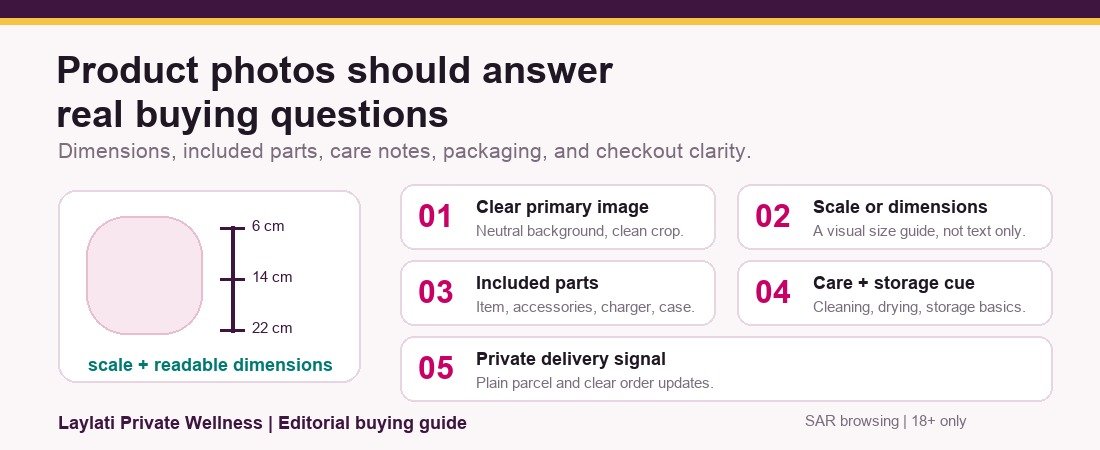
A product photo has a job. It should not merely make an item look attractive; it should answer the questions a careful shopper cannot ask aloud.
That matters even more in private wellness. A shopper may be comparing a compact form, a larger torso-series item, a pump kit, or a starter set while standing in a shared home, using a mobile screen, and trying to finish the order without unnecessary conversation. If the photographs are vague, the buyer is left to guess size, included parts, storage needs, care steps, and delivery expectations. Guessing is not a good foundation for trust.
Recent ecommerce research points in the same direction. Baymard’s 2026 product-page UX benchmark found that product pages remain a weak point for many large retailers, especially on mobile, and that shoppers rely heavily on images when they cannot inspect an item in person. DHL’s 2026 ecommerce report puts delivery trust and checkout expectations near the center of online buying decisions. NIQ’s 2026 wellness coverage describes a consumer who is looking past brand names and judging products by attributes, transparency, and fit.
For Laylati shoppers, the practical lesson is simple: the right product photo set should reduce uncertainty before checkout. It should make the page quieter, not louder.
Start with a clean primary image
The first image should show the item plainly. A clean background, stable crop, and visible outline matter more than dramatic styling. In private wellness, over-styled imagery can create the wrong problem: it looks polished but hides the practical details a shopper needs.
For Realistic Forms, the primary image should make the shape and finish understandable without forcing the visitor to open every gallery image. For Torso Series products, it should show the full silhouette, not just a cropped center detail. For Pumps & Accessories, it should separate the main device from the smaller parts that come with it.
A clear image is not about being clinical. It is about respecting the person who is trying to make a private decision quickly and correctly.
Look for scale, not just written dimensions
Dimensions written in a spec table are useful, but they are not always enough. Baymard’s product-page research notes that many shoppers try to understand size from photos, and its separate dimensions-image guidance explains why visual measurement cues are easier to interpret than text alone.
For private wellness products, this is especially important because category names can hide real-world differences. A compact form and a larger format may sit beside each other in the same grid, but they do not have the same storage needs, parcel size, cleaning routine, or handling expectations.
A good page should answer three size questions:
- How long and wide is the product?
- Which part of the item is being measured?
- Will the item require special storage space at home?
A visual dimensions image is the cleanest answer. It does not need to be complicated. Even a simple annotated product image is better than a vague line that says “large size” or “premium scale.” If the measurement text is too small to read on mobile, the image has not done its job.
Check whether included parts are shown
A buyer should not need to infer what arrives in the parcel. The gallery should show the main item, any accessories, care pieces, storage bag or box, charger, tube, connector, or pump component that is included.
This is one reason Starter Sets need stronger photography than single-item pages. A set is bought because it promises fewer decisions. If the page does not show what the set contains, it gives that advantage away.
For pump kits, the same rule applies. A shopper comparing No. 9 Pump Kit against other formats should be able to see the kit as a complete order, not only a product box. The more components a page contains, the more useful a flat-lay or organized parts image becomes.
Use close-ups to explain material and finish
Wellness shoppers are increasingly looking for product attributes rather than broad claims. NIQ describes this wider shift in health and wellness as a move toward functional benefits, ingredient or material transparency, and personalized fit. In this category, that does not mean making medical claims. It means naming and showing the product details a person can reasonably evaluate before buying.
A close-up image can help explain surface finish, seam quality, firmness impression, texture, and cleaning access points. It should sit beside written material notes, not replace them. If a product page says “soft-touch” or “body-contact material,” the image should let the shopper see what that phrase is trying to describe.
For more detail on reading category differences, the Laylati guide on comparing private wellness product formats is a useful next read.
Do not ignore care and storage
Some product photos should be practical rather than decorative. A care image can show whether the item is easy to rinse, dry, and store. A storage image can show whether the item is compact enough for a drawer, better suited to a box, or needs to be kept with accessories.
This matters because the purchase does not end at delivery. The owner still has to clean it, dry it, store it, and find it again without drawing attention. Laylati’s cleaning and storage basics guide covers the routine in more detail, but the product page should not make shoppers hunt for every practical answer.
The stronger pattern is simple: product image, material note, care note, and storage note should work together.
Packaging and delivery signals belong near the product
DHL’s 2026 ecommerce research shows that delivery and returns trust remains central to online shopping decisions. For private wellness, the delivery question carries extra weight. The product page should not wait until checkout to explain whether the parcel is plain, how notifications are worded, or where to find support if an address detail needs correction.
This does not require dramatic promises. It requires plain information. A useful product page should link clearly to discreet packaging, mention neutral delivery handling, and avoid revealing language in visible order references wherever the store controls that wording.
Saudi shoppers are also increasingly payment-aware. Checkout.com’s 2026 Saudi digital commerce coverage points to frequent online shopping, higher digital-wallet use, and real concern around payment security. A private product page should therefore make the path to payment feel orderly: price in SAR, clear delivery notes, support access, and no unnecessary data requests before the buyer is ready.
Red flags before you add to cart
The quickest way to judge a page is to look for what is missing. A weak product page often has only one or two photos, no scale image, no included-parts view, no readable material notes, and no visible delivery or packaging reassurance. It may look clean at first glance, but it forces too much interpretation.
Be cautious when a page relies on:
- a single cropped product image;
- measurements that are written but not visually explained;
- large claims such as “premium” without material or care detail;
- set listings that do not show every included component;
- checkout or delivery links that are hard to find;
- support forms that ask for more private detail than the question requires.
None of these signals automatically means a product is poor. It does mean the page is asking the shopper to carry more risk than necessary.
How Laylati shoppers can use this checklist
Before choosing between No. 7 Torso Series, a compact form, a pump kit, or a starter bundle, pause on five questions:
- Can I understand the full shape from the first image?
- Can I judge size from a visual measurement cue?
- Can I see every included part?
- Do the material, care, and storage notes match the photos?
- Can I find packaging, delivery, support, and checkout information before I commit?
If the answer is yes, the page is doing its work. If the answer is no, compare another format, read the buying guides, or ask privately before ordering.
Laylati keeps category browsing simple for this reason: start with Realistic Forms, Torso Series, Pumps & Accessories, or Starter Sets, then use the product page to narrow the choice. The right product photo set should help you feel more certain, not more exposed.