
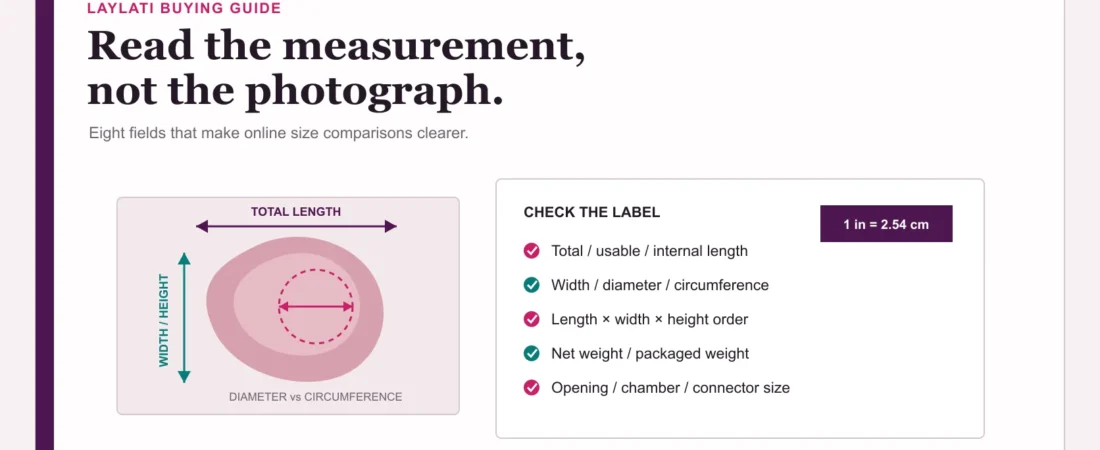
A product photograph can show shape, colour, and finish. It is much less reliable at showing scale. A close crop can make a compact item look substantial; a wide-angle image can do the opposite. The only dependable comparison begins with the specification table.
That is becoming standard ecommerce practice. Salla, a major Saudi commerce platform, recommends using dedicated fields for details such as dimensions and material. Amazon.sa asks sellers to make listings concise, accurate, and easy to understand, while Shopify’s current product-description guidance treats dimensions, materials, functions, and care instructions as basic facts to collect before writing sales copy.
The difficulty is that listings do not always name measurements in the same way. One may show centimetres, another inches. One may list total length, while another gives an internal or usable measurement. Width, diameter, and circumference are often treated as if they were interchangeable, although they describe different things.
This guide explains eight measurements worth checking before buying a soft-touch private-wellness product online. It helps you read a listing; it does not prescribe a personal fit, make a medical recommendation, or replace the manufacturer’s instructions.
1. Find the measurement key before comparing products
Start by asking what each number refers to. Is it the complete product, a usable section, an internal chamber, an opening, a base, an accessory, or the shipping package? A row of numbers without labels is not a complete specification.
Marketing names and model numbers are not measurements. Neither is a photograph beside a familiar object unless the listing confirms that the image is to scale. For products in Laylati’s Realistic Forms and Torso Series, look for a clearly labelled specification block before using an image to judge size.
If a listing shows three figures, do not automatically read them as length × width × height. That order is common, but it is not universal. The seller or manufacturer should identify the order and the unit.
2. Separate total length from usable or internal length
Total length measures the product from one outer end to the other. It may include a base, handle, closed end, connector, or decorative section. It is useful for storage, handling, and judging the product’s overall footprint.
Usable length or internal length refers to a specific working section. The exact meaning depends on the category. On an accessory with a chamber, it may describe the internal space rather than the full exterior. On another item, it may refer to the section between a base and a tip. Do not subtract a guessed base length from the total; use the declared figure.
When comparing two listings, compare total with total and internal with internal. A larger total measurement does not necessarily mean a larger working area.
3. Do not confuse width, diameter, and circumference
Width is a straight-line measurement across a shape. It is the appropriate term for many products that are oval, tapered, or irregular. A listing should say whether it records the widest point or a particular section.
Diameter is a straight line through the centre of a circle. Circumference is the distance around that circle. For a nearly circular section, circumference is approximately diameter multiplied by 3.14. A diameter of 4 cm therefore corresponds to a circumference of about 12.6 cm.
That conversion is only an estimate for a near-circle. It should not be used to invent a precise circumference for an oval or highly contoured form. When the shape is not round, look for separate width and depth measurements.
4. Read length × width × height in the declared order
Overall dimensions are most useful when the order is explicit. Length may describe the longest side; width may describe the side-to-side span; height or depth may describe the remaining axis. The labels matter more than the sequence.
For a larger form or torso-style product, the maximum outside dimensions help answer practical questions: will it fit on the intended surface, can it be handled comfortably, and is there a suitable private storage space? They do not describe every contour.
Convert all candidates to one unit before comparing them. One inch equals 2.54 cm. Avoid rounding repeatedly: convert once, then compare the original figures alongside the converted values.
5. Treat weight as a separate specification
Weight affects handling, support, storage, and delivery, but it is not a shortcut for judging quality or softness. Two products with similar dimensions can weigh differently because of their shape, wall thickness, internal structure, or included accessories.
Check whether the listing gives the net product weight or the packaged shipping weight. The packaged figure may include the box, inserts, accessories, and protective material. If the distinction matters, ask before checkout rather than assuming the larger figure is the item itself.
6. Check compatibility measurements for pumps and accessories
Compatibility depends on connection points, not category names. For a product in Pumps & Accessories, useful fields may include internal chamber length, inner opening diameter, external dimensions, connector size, thread type, tube diameter, or the model numbers supported.
A product described as an “accessory” is not automatically universal. Compare the exact interface measurement and model reference. Laylati’s complete kit versus single accessory guide explains why a complete set and a replacement part should not be evaluated in the same way.
If the listing does not identify the interface, send the product name and the specific measurement you need to private order support. There is no need to send sensitive personal information.
7. Use scale photographs as supporting evidence
A scale photograph is helpful when a ruler or calliper is aligned with the measured section and the camera angle does not distort the view. It is less useful when the ruler is in the background, the product sits closer to the lens, or the image does not show where the measurement begins and ends.
High-resolution images reveal finish and detail, but image quality does not solve a missing measurement. BigCommerce’s current product-page guidance recommends combining technical specifications with photographs that show scale. Both are needed: the picture provides context, while the number enables comparison.
When a model or batch may change, compare the specification with the exact item being sold. The model and batch checking guide explains which identifiers are useful when confirming a product version.
8. Allow for material, tolerance, and storage
A soft-touch material can flex under pressure, so a maximum outside measurement and a relaxed measurement may not be identical. That does not justify guessing how much a product will compress. Use the manufacturer’s nominal dimensions and ask about measurement tolerance when compatibility or storage clearance is critical.
Also distinguish product size from package size. The shipping parcel may be larger because of protective material, while the neutral outer packaging should avoid a sensitive description. Product dimensions answer whether the item fits your intended space; package dimensions answer a different delivery and storage question.
A practical eight-point comparison
- What part of the product does each number measure?
- Is the length total, usable, or internal?
- Is the cross-section given as width, diameter, or circumference?
- Is the order of length, width, and height stated?
- Are all products being compared in the same unit?
- Is the weight net product weight or packaged weight?
- Are opening, chamber, connector, and model details included where relevant?
- Does the scale image agree with the written specification?
A clear specification should reduce uncertainty, not create it. When one measurement is undefined, ask for that field before ordering. A short question such as “Is 17 cm the total exterior length or the internal length?” is more useful than trying to infer scale from a photograph.