
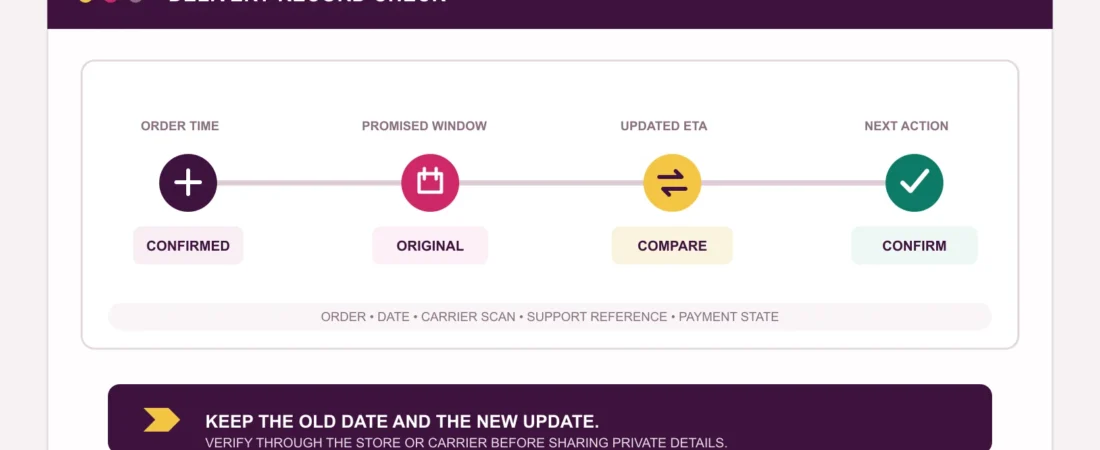
A delivery date can change without changing the order. The useful question is not only “Where is the parcel?” but “Which record changed, who changed it, and what still matches the purchase?”
That distinction has current relevance in Saudi ecommerce. On 10 June 2026, the Saudi Ministry of Commerce announced action against an online store after products were not delivered within the agreed periods, customers were not notified of expected delays, and requests concerning cancellation and repayment were not handled. The enforcement notice concerned another retail category, but the operational lesson applies broadly: a promised date, a later update, and a tracking scan are not interchangeable records.
This guide explains how a shopper can compare those records calmly and privately. It is not legal advice, and it does not state a guaranteed Laylati dispatch or delivery time. The date shown in the live order and shipping information is the starting point for each individual purchase.
1. Save the delivery promise that existed when you paid
Begin with the record created at checkout. It may be an order confirmation, invoice, payment page, or account screen. Look for the delivery method, destination, delivery charge, dispatch estimate, arrival window, and any conditions attached to that estimate.
The Saudi Ministry of Commerce consumer guide says an electronic invoice should show the delivery date and location, as well as payment and delivery arrangements. Even when a store presents those details in separate records, the practical aim is the same: you should be able to identify what was agreed without reconstructing it later from memory.
Keep the original email or downloadable document where possible. A cropped screenshot may omit the date, sender, order reference, or qualification such as “after dispatch” or “business days.” Laylati’s guide to order confirmations and electronic invoices explains why those records should be saved separately.
2. Separate the store’s promise from the courier’s estimate
A store and a courier can show different dates because they describe different stages. The store may estimate when the order will arrive. The courier may estimate the next movement after collecting the parcel. A tracking page created before collection may only show that a label or shipment record exists.
Write down four moments:
- the order time;
- the promised dispatch or arrival window;
- the first carrier acceptance scan; and
- the newest estimated delivery date.
If the date moves, ask whether the parcel has actually entered the carrier network. “Shipment information received” is not the same as “parcel collected.” Laylati’s guide to verifying a delivery tracking message shows how to open the carrier’s official tracking route instead of trusting a link in an unexpected message.
3. Check whether the update is genuine before responding
Delivery changes are common material for phishing messages. A text may claim that an address is incomplete, a small fee is due, or a parcel is on hold. Do not reply with an identity number, bank information, payment code, or full address simply because the message includes your name.
Open the store account or the courier’s official website independently. Enter the tracking reference there and compare the status. The order number, carrier name, destination city, and latest scan should make sense together. If the message asks for a new payment, confirm the reason through the store or courier channel you already know.
A genuine update can still be incomplete. Save the message, but do not let its wording overwrite the original purchase record. The original promise and the later update are both part of the timeline.
4. Rule out an address or contact problem
A date can change because the delivery address is incomplete, a mobile number is unreachable, the recipient was unavailable, or the courier needs a location detail. Compare the address on the order with the address shown in the carrier record. Check the city, district, street, building, postal code, and phone number without posting them publicly.
If something is wrong, request a correction through the official support route and save the confirmation. Do not assume an edited address is active until the store or courier acknowledges it. The Laylati address-correction guide explains which details to provide and which sensitive information to withhold.
The Transport General Authority’s published postal-customer rules say providers should publish procedures for undelivered items, delivery attempts, returns, and address changes. The exact process and any charge depend on the provider, so use the carrier’s current published procedure rather than a generic social-media answer.
5. Build one short timeline instead of sending many screenshots
Support teams can act faster when the question is precise. A useful timeline can fit in five lines:
- order reference and order date;
- original delivery window;
- payment state;
- latest carrier scan and updated estimate; and
- the action you need confirmed.
For example: “Order placed on [date], original arrival window [date], payment completed, carrier status unchanged since [date]. Please confirm whether the parcel has been handed to the carrier and provide the current expected date.”
This is usually more useful than forwarding a full payment statement or a gallery of screenshots. Share the minimum information needed to identify the order. Remove unrelated account balances, card fragments, home details, and product descriptions when they are not required.
6. Ask for a specific next action
“Where is my order?” may produce a generic reply. Ask a question that can be answered:
- Has the parcel been handed to the carrier?
- Which carrier and tracking reference are active?
- What is the revised delivery window?
- Is an address correction or delivery appointment required?
- If delivery cannot be completed, what cancellation or repayment process applies to this order?
Keep the response and its timestamp. If you use telephone or chat support, note the case reference and the agreed next step. Do not publish a private order reference in a public comment to obtain attention.
The Ministry of Commerce has previously called for ecommerce stores to display an arrival date at purchase and to make cancellation and refund processes easier to follow. A clear answer should therefore identify the revised date or the next process, not simply say “please wait” without a reference.
7. Track the money separately from the parcel
A delayed parcel and a completed payment are two different status lines. If a cancellation or repayment is agreed, save the date, amount, currency, method, reference, and stated processing window. “Cancellation requested,” “order cancelled,” “refund initiated,” and “refund received” are not the same event.
Do not remove the order and delivery records as soon as a refund message appears. Keep them until the payment provider shows the final outcome. If a replacement shipment is arranged, keep the original and replacement tracking references together.
If the parcel eventually arrives with visible damage or an opened outer package, stop and document its condition before use. The damaged or opened parcel checklist covers the photographs and handover details worth preserving.
A two-minute delivery-date check
- Save the original delivery method, window, destination, and order reference.
- Confirm whether the courier has physically accepted the parcel.
- Verify any update through the store account or carrier’s official site.
- Compare the address and contact details without exposing them publicly.
- Write one short timeline with the old date, new date, and latest scan.
- Ask support for one specific next action and save the case reference.
- Record cancellation, repayment, replacement, and delivery as separate events.
A changed date is easier to resolve when the records stay clear and private. Review Laylati’s live shipping and delivery information, then use private order support with the order reference and the exact point that needs confirmation.
Sources
- Saudi Ministry of Commerce, enforcement notice concerning delayed ecommerce deliveries and missing delay notifications, 10 June 2026
- Saudi Press Agency, report of the Ministry of Commerce enforcement notice, 10 June 2026
- Saudi Ministry of Commerce, Guide to Consumer Rights and Responsibilities, ecommerce records and delivery information
- Transport General Authority, Rules for Protection of Rights of Postal Services Customer
- Saudi Ministry of Commerce, ecommerce initiatives covering arrival dates, cancellation, refunds, and delivery alternatives